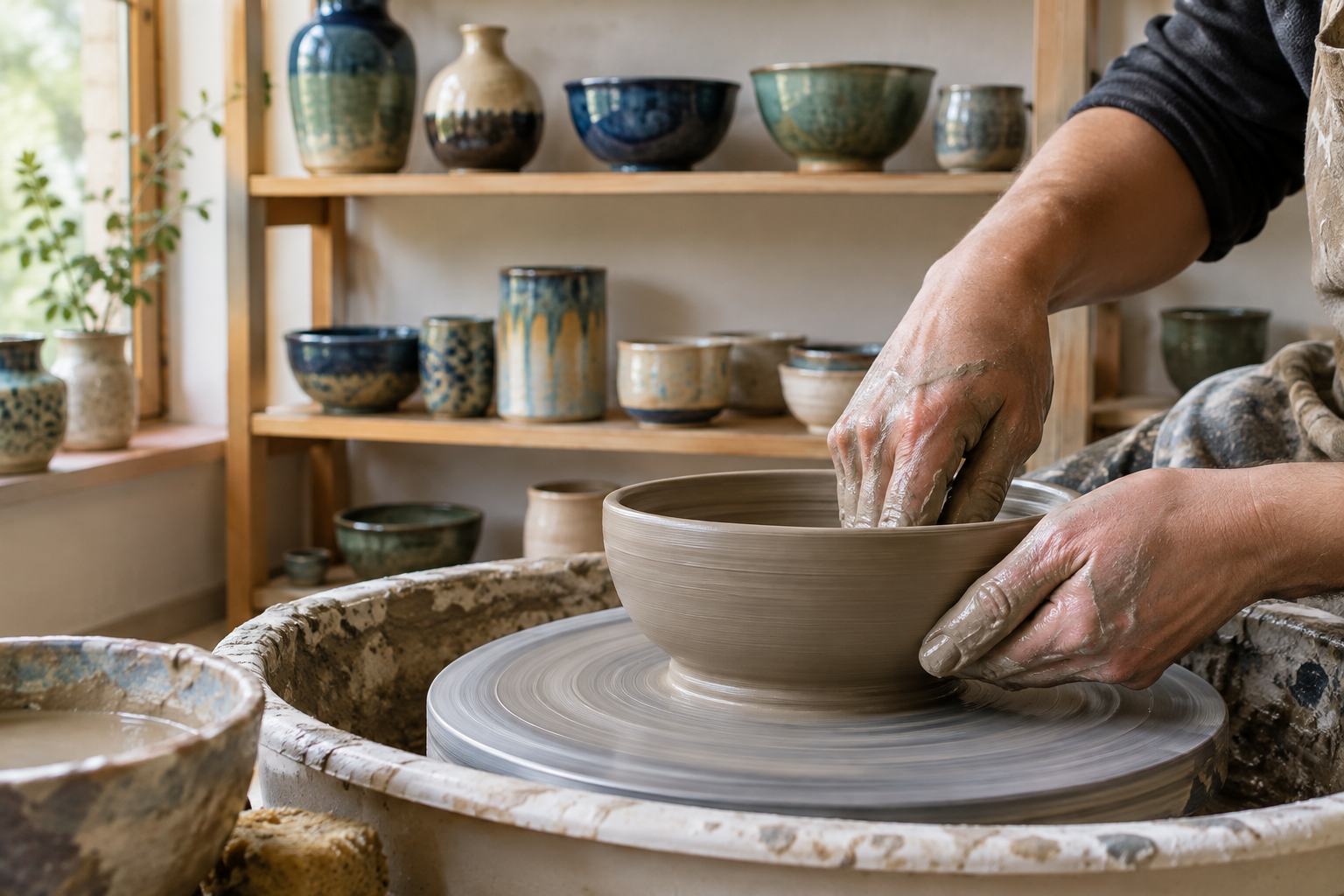
To explore Vallauris ceramics thoughtfully, begin with three questions: what was the object intended to do, who was responsible for making it, and what documentation accompanies it? When comparing a serving bowl, a studio vessel and a numbered artist edition, give each a different line of inquiry rather than assuming a hierarchy of importance.
This Vallauris ceramics guide offers a way to look before you buy—and to enjoy looking without buying. To investigate a claimed connection between a ceramic object and Vallauris, seek out museum interpretation and makers’ records rather than treating a place name, signature or edition number as a complete explanation. For any particular piece, keep documented information separate from a seller’s description and your own visual response. The approach here is a framework for examining evidence, not an authenticated history or catalogue of individual works.
Start with the object, not the prestige
Begin with three working lenses: function, authorship and production format. Consider each separately before deciding how to describe an object.
For functional pottery, concentrate on intended use: holding flowers, serving food, pouring water or accompanying a daily ritual. For studio ceramics, investigate the maker’s decisions about form, surface and process. For an edition, ask how the object relates to a defined group of works, and who authorised or produced that group.
As a hypothetical example, imagine a maker-designed jug offered as part of a documented series. You would want to ask about its practical use, its design and its production format, rather than choosing only one line of inquiry. Conversely, if you are considering a one-off vessel shaped like a bowl, request confirmation of its intended use before putting it on the table.
Before asking whether something is important, ask what you are actually looking at. Describe its silhouette, scale, weight, opening, foot and surface. Then read the label. Give your own observation a place alongside names and attributions, rather than allowing them to determine every response.
Investigate Vallauris through museum and maker records
When researching ceramics associated with Vallauris, look for documented connections between objects, people, workshops, uses and places. Resist the temptation to organise your entire visit around a single famous name or an assumed local style.
For a museum visit, choose a small group of objects and examine how their labels establish context. Does the interpretation identify a maker, designer, workshop or publisher? Is the date precise or approximate? Does it distinguish where an object was conceived from where it was made? Record the wording rather than silently making it more definite.
For a maker or gallery visit, ask similar questions in conversational terms. Who shaped the object? Who developed or applied its decoration? Was it made as an individual work, part of a recurring range or a defined edition? Request written documentation for any detail that matters to your decision.
Examine museum and maker documentation separately. If you notice similarities between a museum object and a piece offered elsewhere, treat that resemblance as a research question. Ask for evidence specific to the second object before adopting the museum attribution. Likewise, seek supporting records before extending a current maker’s account into a historical attribution.
For a break from object-focused research, consider browsing Lifestyle. Keep that reading separate from the evidence you collect about a particular ceramic piece.
Functional pottery: begin with the intended use
Make your imagined use specific. A vase for a narrow shelf asks different practical questions from a generous serving dish or a cup you intend to hold each morning.
If handling is permitted, assess the object in the way you expect to use it. Consider the handle’s clearance, the rim’s shape, the balance between body and base, and whether the underside might mark a delicate surface. Ask permission before lifting lids or moving pieces from their display.
Before using an object for food, heat or machine washing, request explicit instructions for that particular piece. Do not substitute your impression of a glossy interior, substantial wall or familiar shape for written guidance about the use you have in mind.
Questions to ask before choosing tableware
- Is this specific piece intended for contact with food or drink?
- Are there restrictions involving heat, acidic foods, soaking or cleaning?
- What care instructions are supplied in writing?
- Are visible surface variations intentional, or should they be examined as possible damage?
- Is it intended for daily handling or occasional decorative display?
If the answers remain unclear, consider a decorative role instead—or leave the piece until you have the information you need. There is no need to turn an uncertain attribution or care claim into a purchase decision on the spot.
Studio ceramics: look for decisions, not just irregularities
When considering studio ceramics, examine how the object holds together visually. Follow the profile from base to lip. Look at where the surface changes and how decoration meets the form. Ask yourself whether a detail becomes more interesting as you move around it.
Avoid using irregularity as a shortcut for authorship or quality. When you notice an uneven rim, ask how it was formed and what documentation supports the attribution. When a vessel is restrained and symmetrical, give it the same attention: examine its proportions and ask about the decisions behind them rather than dismissing it on appearance alone.
Ask the maker or representative to explain the relationship between design and execution. Where several people are named as contributors, seek a clear account of their roles rather than assuming that the most prominent name performed every stage.
For a work described as unique, clarify what that means. Is the exact object unique, while its form belongs to a continuing series? Is the decoration individually varied? Does the description refer to a one-off commission? Preserve the precise wording on the invoice or accompanying record.
The practical question is not simply whether you can recognise a maker’s style. Ask whether you understand enough about this object to choose it deliberately.
Artist editions: understand the framework
Approach an edition through its documentation rather than concentrating only on a number written on the underside. Before assigning significance to a marking, ask what it refers to and how that interpretation is supported.
Request records that identify the artist or designer and, where relevant, the workshop, manufacturer or publisher. Ask how the edition is defined, whether its stated size is recorded, and how the individual object is identified within it.
Do not assume that objects bearing the same design belong to the same edition. Equally, avoid inferring uniqueness from differences in surface or colour. Treat both possibilities as questions for the accompanying records.
Read the paperwork as closely as the surface
Check that the object description, dimensions, markings and photographs correspond to the piece in front of you. If a certificate is provided, ask who issued it and what claim it actually makes. Read separately for statements about origin, production and condition; request clarification wherever the wording leaves your question unanswered.
Avoid treating a low number, signature or attractive certificate as an independent reason to buy. Consider the object first, then the clarity of its attribution, condition and edition records. If future resale matters to you, seek independent advice rather than interpreting edition status as a financial promise.
A practical comparison for your visit
Use this table to organise questions, not to rank categories. Consider applying more than one row to the same object.
| Lens | First question | What to examine | Documentation to request | Assumption to avoid |
|---|---|---|---|---|
| Functional pottery | What do I want to use it for? | Grip, balance, rim, base and capacity | Intended use and care instructions | Treating a familiar shape as confirmation of suitability |
| Studio ceramics | Which decisions make this object compelling? | Profile, surface, transitions and viewing angles | Maker attribution and explanation of production | Using irregularity as proof of individual authorship |
| Artist edition | How is this object related to the edition? | Markings, correspondence with records and condition | Edition details and identified contributors | Assigning significance to a number alone |
| Decorative object | Where and how will I display it? | Stability, scale, underside and sightlines | Materials, care and any attribution being claimed | Skipping condition checks because use is decorative |
| Previously owned piece | What is known about this example? | Wear, possible repairs and completeness | Available provenance and condition information | Inferring a date or maker from a place name |
For a separate reading interlude, browse Magazine. Return to the individual object’s records when evaluating an attribution.
A step-by-step method for looking and choosing
1. Define your purpose before entering
Decide whether you are researching, choosing something for daily use, furnishing a space or considering a collection. Set your own spending boundary, but avoid making price the first interpretive tool. Write down any practical constraints, including shelf depth, carrying arrangements and intended use.
2. Make an initial visual selection
Choose a few objects that genuinely hold your attention. Describe each in plain language before reading every claim attached to it. Try a note such as “wide opening, narrow foot, dark exterior” before adopting an evaluative word such as “important.”
3. Read and record exact descriptions
Note the attribution, title if supplied, materials, dimensions and date wording. Preserve “by,” “attributed to” and other qualifying language rather than treating them as equivalents. Ask before photographing objects or labels, and respect any restrictions.
4. Examine condition with permission
Ask to see the base, interior and any areas concealed by display supports. Request an explanation of visible cracks, chips, repairs or surface differences. Do not perform improvised tests, scratch a surface or add water. If condition is central to a substantial purchase, consider independent specialist assessment.
5. Match evidence to your decision
For a breakfast bowl, decide whether unresolved care instructions should stop the purchase. For an attributed historical object, consider how uncertainty about authorship affects your interest. For a numbered work, clarify the edition documentation. Concentrate on the unanswered questions that could actually change your choice.
6. Keep the record together
If you buy, retain the invoice, written description, care information and any supporting documents. Ask for relevant verbal statements to be recorded accurately. Where delivery is involved, clarify packing, responsibility for transport and the applicable terms before committing.
Three fictional cases to test your priorities
The following scenarios are invented illustrations, not accounts of actual makers, objects or transactions.
A bowl intended for everyday meals
A visitor loves a broad, softly coloured bowl and imagines using it for breakfast. The seller can discuss its appearance but cannot provide clear food-contact or cleaning guidance. Rather than assuming suitability, the visitor postpones the decision and asks for written clarification. A decorative use remains an option, but only if that genuinely suits the visitor’s wishes.
A studio vessel for a narrow console
A second visitor is drawn to a tall vessel with an asymmetrical opening. Its visual character is appealing, but the proposed display location is shallow and busy. The visitor requests dimensions, studies the base and checks the intended position at home. The decision centres on the relationship between object and setting, not on whether asymmetry makes it more artistic.
A numbered work with incomplete records
A third visitor finds an editioned object whose marking is legible but whose accompanying description leaves the producing workshop unclear. The visitor asks for documentation connecting the object to the stated edition. If that connection cannot be established, the visitor chooses to pause rather than fill the gap with confidence borrowed from a recognisable name.
Errors worth examining before you commit
Before deciding, test your reasoning against these possible shortcuts:
- Confusing location with attribution. Ask whether Vallauris describes the place of purchase, claimed production location or documented connection.
- Treating a signature as a complete history. Examine what supports its reading and attribution.
- Assuming handmade means unique. Request a precise description of the production format.
- Reading condition from a flattering angle. Ask to inspect areas hidden by the display.
- Accepting a spoken promise instead of usable instructions. Request written clarification where the detail matters.
- Buying for an imagined future value. Separate your enjoyment of the object from unsupported expectations about resale.
After a visit, return to your notes before seeking more objects. Compare what attracted you with what remains uncertain. For a change of pace, return to Lookbook; keep any ceramic attribution grounded in the object’s own records.
FAQ
Is functional pottery less interesting than studio ceramics?
There is no need to adopt that hierarchy. Compare objects according to your purpose and response. For a useful vessel, examine handling and documented suitability; for a contemplative object, spend more time with form, surface and display. Where appropriate, apply both approaches rather than forcing a single category.
Does a Vallauris marking identify the maker?
Do not treat the place name alone as a complete attribution. Ask how the marking has been interpreted and what documentation connects the individual object to a maker, workshop or production context. Keep uncertain information explicitly uncertain.
Should I choose a unique work or an edition?
Start with the object you want to live with and the information available about it. Ask what “unique” means in the first case and how the edition is defined in the second. Examine condition and your own response before allowing either description to decide the purchase.
What should I leave a visit knowing?
Aim to explain why an object interests you, what is documented about it, which questions remain open and whether it suits your intended use. Make those your criteria for a worthwhile visit, even when you leave empty-handed.