

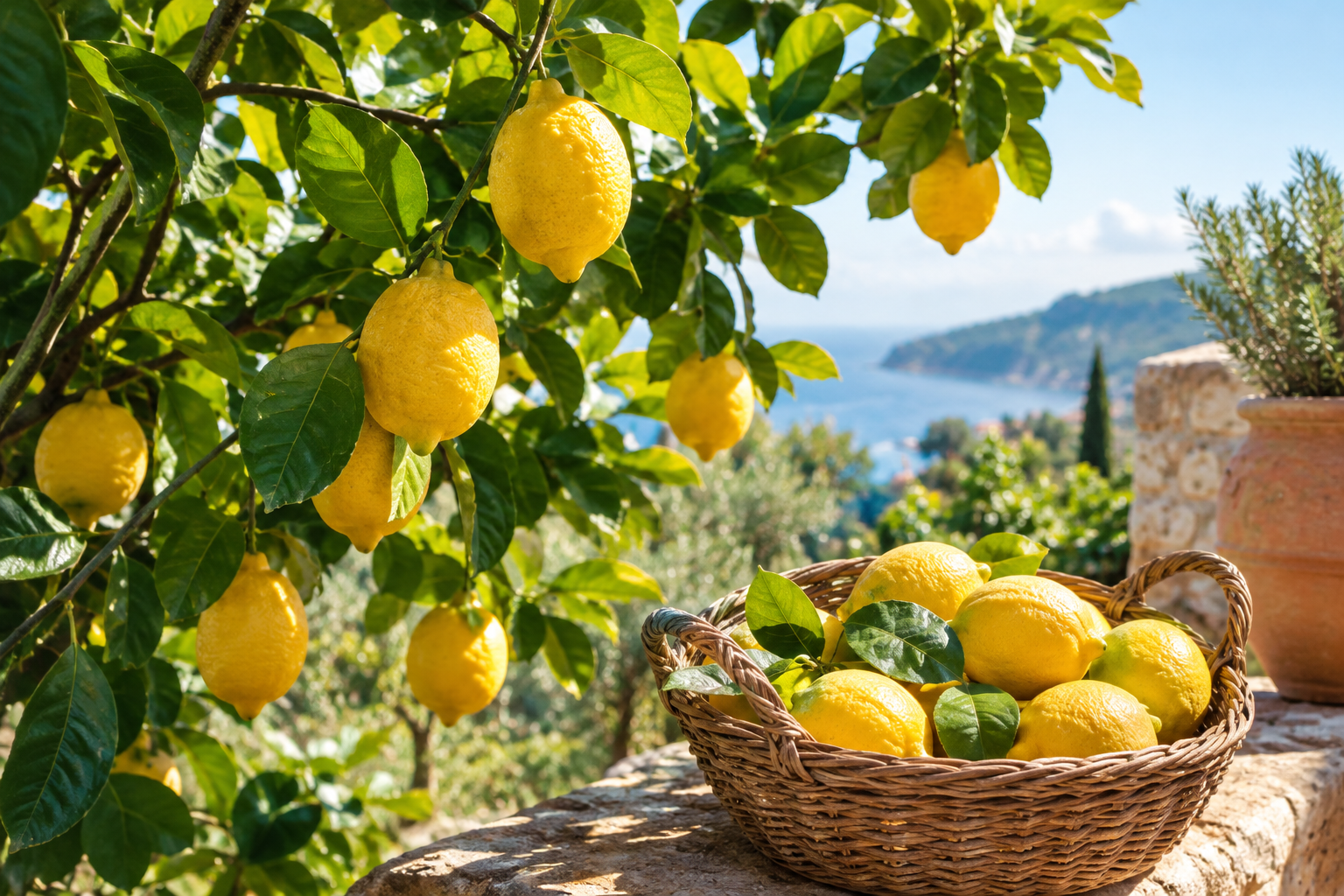
To explore what makes Menton’s lemon culture distinctive, begin with three connected questions: where was the fruit grown, how are its growing conditions documented, and what does a cook do with it? When shopping, ask for evidence of growing origin rather than relying on an association with Menton.
Start with provenance, then consider culinary purpose. Ask whether the place name describes the fruit’s origin, the place of manufacture, a recipe or simply the presentation. Use those answers as your basis for choosing, rather than picturesque packaging or an evocative menu description.
This guide takes an evidence-conscious approach to Menton lemon gastronomy. Treat particular growing boundaries, cultivation rules, protected status and flavour characteristics as subjects to verify in agricultural documentation before relying on them. The method below is intended to help you examine those subjects and explore connections between landscape and cooking without assuming the conclusions in advance.
Begin by separating origin from association
Before treating a place name as proof of agricultural origin, ask exactly what it describes on the label you are reading.
For a fresh lemon, begin by asking where the fruit was grown. For a preserve, pastry or drink, extend your enquiry: where did the ingredients originate, where was the product made, and which ingredient is being presented as regional?
Use these five headings as a shopping checklist:
- Agricultural origin: ask where the lemons were grown.
- Manufacturing location: ask where the product was prepared or packed.
- Recipe identity: ask which culinary tradition or style is being referenced.
- Retail location: record where you are buying the item, separately from its stated origin.
- Documented designation: ask whether a named scheme applies and request its current requirements.
Investigate each question separately. If a seller identifies a local workshop, follow up by asking about the lemons. If a restaurant describes a regional dessert, ask whether that description refers to its ingredients or its preparation.
You need not dismiss a product because its identity rests on a recipe rather than local fruit. The aim is to understand what you are buying and decide whether it matches your purpose.
Read geography as a set of questions, not a tasting guarantee
To investigate the relationship between citrus growing and landscape, look for agricultural documentation that explains the production area and identifies the conditions relevant to cultivation.
For Menton, useful research questions would include: What geographical boundary does the document describe? Does it discuss elevation, exposure, shelter, soil or water management? Does it distinguish the wider locality from individual growing sites? What evidence connects those observations to the fruit?
Avoid moving directly from a coastal view to a conclusion about sweetness, fragrance or peel quality. Instead of using a landscape photograph to support those characteristics, seek a document that addresses them explicitly. Likewise, look for orchard-level or harvest-specific evidence before applying a general description of regional weather to a particular purchase.
What to look for in an agricultural document
When you find a specification, technical report or producer record, examine its scope before extracting a memorable detail:
- Identify the issuing organisation and publication date.
- Check whether the document concerns lemons specifically.
- Separate mandatory requirements from descriptive background.
- Note whether its conclusions apply to a defined area or a particular sample.
- Look for cultivation and harvesting information, not just regional history.
- Keep geographical evidence separate from sensory descriptions.
Use this approach to give geography a precise role in your enquiry. Rather than treating the landscape as decoration, ask how the source connects a place, a growing practice and a product.
If that connection remains undocumented, leave it open. Prefer an unanswered question to a confident explanation assembled from travel imagery.
Connect provenance to the part of the lemon you will use
Before shopping, decide what the lemon needs to do in your kitchen. Rather than asking broadly for lemons “for cooking”, identify the preparation: a dressing, zest for a cake, a preserve or thin slices for serving.
For a juice-led recipe, consider a small trial before committing to a larger purchase. Record how much juice your recipe requires and taste the finished preparation before adjusting it. Do not assume that a named origin tells you exactly how the result will taste.
For a peel-led recipe, ask specifically about treatments and suitability for the intended use. Follow the product’s handling instructions and an appropriate recipe. Do not interpret a regional name as an answer to a handling question.
For preserves and desserts, read the ingredient list alongside the front label. Ask which lemon components are used and whether their origin is identified. Examine the description of the finished product, then separately seek documentation for the ingredients that matter to you.
A useful buying brief might be: “I want lemons for a cake in which the zest is important, and I would like documented Menton origin.” Try giving the seller those two concrete requirements rather than inviting a general recommendation.
A practical comparison for shopping
Use this table to decide what to ask and what to examine. It compares purchasing situations, not the quality or authenticity of individual products.
| What you are considering | Main question | Evidence to examine | Culinary question | Assumption to avoid |
|---|---|---|---|---|
| Fresh lemons sold loose | Where was this batch grown? | Origin information and any available batch documentation | Will you use juice, peel or both? | The shop’s location proves the fruit’s origin |
| Packaged fresh lemons | What does the stated origin cover? | Label wording, packer details and traceability information | Is the product suitable for your planned preparation? | Every geographical reference describes the orchard |
| Marmalade or another preserve | Where did the lemon ingredient originate? | Ingredient list and any specific origin statement | What balance of peel, texture and sweetness do you prefer? | Local manufacture establishes local fruit |
| A pastry or plated dessert | Does the place name refer to an ingredient or a recipe? | Menu wording and a precise answer from the kitchen | How is lemon used in the dish? | The dish name documents every ingredient |
| A lemon-flavoured drink | What supplies the lemon element? | Ingredient information and a clear product description | Does the style suit how you intend to serve it? | Regional imagery establishes ingredient provenance |
| A gift assortment | What can be established about each item? | Individual labels rather than the outer box alone | Does the recipient want ingredients or ready-to-eat products? | Every item shares the same origin story |
For reading alongside your food-focused itinerary, browse the lifestyle archive. Keep the provenance checks above as a separate part of planning any purchase.
A step-by-step method for recognising provenance
1. Define what matters to you
Choose your priority before entering the shop. You may want documented fruit origin, a locally prepared souvenir, a particular recipe or simply something enjoyable to eat. More than one goal is possible, but name them separately.
If agricultural origin is essential, decide in advance that an attractive regional presentation will not substitute for it.
2. Read the exact wording
Look for the phrase that actually describes the lemons. Do not stop at the largest place name on the package. Check whether the wording concerns growing, making, packing or selling.
Where the description is ambiguous, ask the seller to identify which interpretation is intended. Avoid supplying the answer yourself with a leading question.
3. Ask one precise follow-up
Try: “Were the lemons used in this product grown in Menton, and what information confirms that?”
For fresh fruit, ask about the batch in front of you. For a prepared product, ask about the ingredient rather than the workshop alone. After hearing the answer, identify which details are supported by documentation and which remain part of the seller’s explanation.
4. Examine any designation carefully
If a label refers to a certification or protected designation, check its exact name and consult the current official documentation before relying on it. Establish which product is covered and what the requirements address.
Do not assume that a mark on one product extends to everything sold beside it. Equally, do not infer a designation’s rules from its name or visual appearance.
5. Record what is known and what remains uncertain
Consider making a brief note under three headings: the label’s statement, the seller’s explanation and the documentation you actually examined. Refer to it if you plan to describe the purchase later.
You might record: “Made locally; fruit origin not established.” Prefer that wording to upgrading a partial answer into a complete provenance claim.
6. Buy for the intended use
Once provenance is sufficiently clear for your purpose, return to the practical decision. Consider quantity, storage instructions, transport and the recipe you intend to make. If uncertainty remains, choose a smaller trial purchase or look for a more clearly documented alternative.
Three fictional shopping situations
The following examples are fictional. They illustrate decisions, not actual businesses, products or encounters in Menton.
The souvenir preserve
A visitor, Amelia, finds a preserve with an illustrated Menton label. She wants a gift made with fruit grown there. The seller can explain where the preserve was cooked but cannot establish the lemons’ origin.
Amelia has two reasonable options: buy it as a locally prepared souvenir, while keeping its agricultural origin unresolved, or continue looking for a product with clearer ingredient documentation. What she should not do is describe the purchase later as verified Menton-grown lemon preserve.
The zest-focused home cook
Daniel plans to bake a lemon cake and wants to explore a named origin. He asks where the fruit was grown, then separately asks about treatment and suitability for using the peel.
He buys a small quantity and follows his recipe and the handling guidance provided. In his kitchen notes, he records the fruit used and the adjustments he made. If the cake pleases him, he can describe that particular result without declaring that every lemon from the area will behave identically.
The restaurant guest
Sofia orders a dessert whose name references Menton. She asks whether that refers to the lemon ingredient or the style of the dish. The server needs to check with the kitchen.
Sofia allows the answer to remain open until it is confirmed. If the kitchen cannot establish the ingredient’s origin, she can still enjoy and discuss the dessert without assigning it an agricultural provenance it has not demonstrated.
Explore gastronomy without turning preference into proof
Once you have considered provenance, try a deliberate tasting exercise. Keep the questions modest and observable: What do you notice in this preparation? Which component stands out? Would you change the recipe next time?
For a small home comparison, consider using the same recipe and changing only the fruit. Label your preparations, record the quantities you use and taste without looking at the labels first if practical. Treat the exercise as personal exploration, not as an agricultural study.
Keep observations tied to the sample. Consider writing “I preferred this batch in this cake” rather than “This origin always produces better cakes.” Limit your conclusion to the preparation you actually tried.
Also distinguish the fruit from the cook’s decisions. When comparing two finished preserves or desserts, do not attribute every difference to lemon origin without considering the recipes and preparation. Ask for ingredient information where available, and accept when a meaningful comparison is not possible.
To place a food-focused excursion within a wider reading list, explore the magazine archive. Use that browsing as inspiration, rather than as a substitute for product-level checks.
Mistakes worth examining before you buy
Treating atmosphere as evidence. Before drawing conclusions from a market setting, decorative crate or regional illustration, return to the origin statement. Ask what documentation supports your interpretation of the presentation.
Confusing the maker with the grower. Ask both where a product was prepared and where its lemons were grown. Keep both answers in your notes.
Using flavour to authenticate origin. Enjoy tasting, but do not replace provenance records with a sensory guess. If you think you recognise an origin, treat that impression as a prompt to check the documentation, not as your final answer.
Overlooking the intended use. Clarify your recipe before asking for advice. For juice, ask questions relevant to your planned preparation; for peel, ask explicitly about treatments, handling and suitability for that use.
Repeating a broad claim more confidently than its source. If a seller says the product follows a regional recipe, preserve that qualification when describing it to someone else.
Demanding certainty, then inventing it when unavailable. If information is incomplete, state the gap. You can still make a purchasing decision without resolving every question.
For further editorial browsing beyond this guide, start at the Lookbook homepage, while checking current product details directly when planning a purchase.
FAQ
Does buying a lemon in Menton establish that it was grown there?
Do not use the point of sale as your evidence of growing origin. Check the origin information for the fruit being offered and ask about the specific batch. If no supporting information is available, keep the origin unresolved.
What should I ask when buying a lemon-based souvenir?
Ask what the geographical wording describes: the lemon ingredient, the place of manufacture or the recipe. Then examine the ingredient list and any available origin statement. Choose according to the kind of souvenir you actually want, rather than assuming those categories are equivalent.
How can I investigate claims about geography and flavour?
Look for a current agricultural document with a clear issuing body, defined scope and an explanation of the relationship being claimed. Separate its geographical descriptions from any sensory findings. Without that evidence, frame the connection as a question to research rather than an established characteristic.
What is the simplest rule for exploring Menton lemon gastronomy?
Verify origin separately from evaluating taste. First establish what the available information supports; then choose and cook according to your preferences. Enjoy the discovery while keeping your descriptions of the place, the fruit and the finished dish as precise as the evidence allows.