

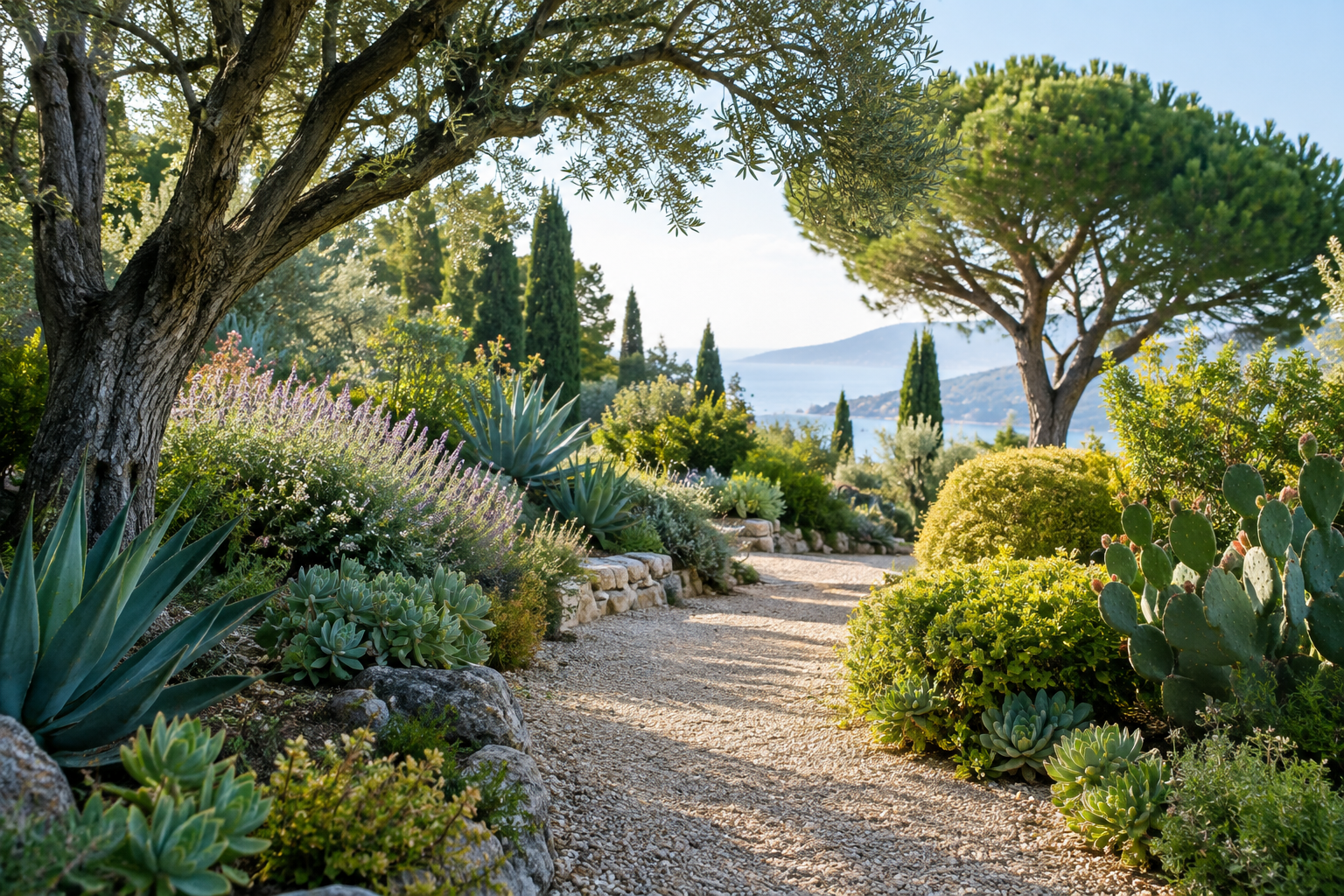
To explore Monaco through its gardens, begin with a question rather than a checklist: what does each landscape ask you to notice? Compare the treatment of stone and water, the shapes of leaves, the relationship between shade and movement, and the way a view is framed. Then build a short itinerary around contrasting experiences, checking official access information before committing to any stop.
Use this Monaco gardens guide to develop a shortlist around three interests: spatial composition, flowering displays and botanical observation. These are suggested approaches, not a confirmed itinerary. Before choosing named destinations, verify their identity, current opening arrangements, public access, accessibility and any restrictions through the relevant official visitor information.
Try reading a garden as a designed response to its surroundings. Alongside the pleasure of flowers or a striking outlook, look for decisions: where a path turns, how planting meets masonry, what remains exposed and where shelter begins. Use those observations to consider the Principality’s relationship with the Mediterranean, without reducing every garden to a picturesque backdrop.
Choose your gardens by the questions they raise
A useful selection need not be exhaustive. Consider choosing two contrasting garden experiences, then keeping another as a possible alternative once access has been checked. Leave room to look closely rather than turning a visit into a sequence of arrivals and departures.
For a composition-led visit, investigate the relationship between planting, stone, water and the visitor’s route, wherever these elements are present and visible. Avoid assuming that every feature has a particular symbolic meaning. Record what you can actually see, then distinguish that observation from any interpretation you later research.
For a flower-focused visit, use planting structure as your question. If your visit coincides with flowering, compare flowers with the framework around them: beds, edges, paths and intervals. If it does not, ask whether the layout still gives you something worth studying. Do not build the entire outing around an unverified expectation of blooms.
For a botanical visit, investigate whether current visitor arrangements support the experience you want. If access is confirmed, consider making plant form and terrain your observational themes. Do not infer opening status, accessible routes or available facilities from a garden’s name or older travel coverage.
These are suggested reading lenses, not verified descriptions of current conditions. Apply them only to gardens whose identity and access you have confirmed.
Read landscape design before reaching for the camera
Start at the entrance and pause. Before photographing a detail, ask where the design directs your attention. Is there an obvious destination, a partial glimpse or a choice between routes? Does the space invite you to linger, or does its layout encourage forward movement?
Try separating your observations into three scales.
- The whole composition: look at the relationship between open space, planted areas and built edges.
- The walking experience: notice turns, changes of surface, thresholds and places to stop.
- The individual detail: examine a leaf, a joint in the paving, a plant label or the edge of a bed.
Move between these scales rather than remaining at the level of decorative detail. If a flower holds your attention, consider the position from which you encounter it too. Ask whether a narrow approach, a change in direction or an opening in the planting influences that encounter.
Be precise about interpretation. “The path turns before the next open space” could be an observation in your notes, if that is what you see. Before writing “The designer intended a moment of suspense,” seek evidence of that intention. Alternatively, describe how the turn felt to you.
For a separate browsing session after your visit, try the Magazine section. Keep your garden notes rooted in your own observations rather than borrowing the language of a different subject.
Examine plant adaptation without guessing
Make plant adaptation a research question rather than a conclusion drawn from appearance. Start with visible characteristics, then decide what botanical information you would need before offering an explanation.
Look for differences in leaf size, thickness, colour and surface. Compare upright forms with spreading ones. Notice whether planting is grouped closely or separated by exposed ground. If there are labels, record the names accurately before seeking reliable botanical information later.
Try dividing a notebook page into three columns: what you observed, what you wonder, and what remains to verify. For example, “small, pale-looking leaves” belongs in the first column if it accurately describes your observation. “Might this relate to exposure?” belongs in the second. Reserve the third for a researched explanation, with its supporting reference.
Do not label a planting scheme drought-tolerant, native, sustainable or low-maintenance merely because it looks spare or contains sculptural plants. Before using those descriptions, seek documentation about the relevant species, growing conditions or management. If you notice irrigation equipment, record its presence without estimating operating frequency or water consumption.
Keep the exercise proportionate to your interest. Consider simply describing the contrast between a glossy leaf and a rough stone surface without attaching an environmental explanation to either. If a botanical question particularly interests you, take it away for research rather than trying to settle it during the walk.
Consider the Mediterranean as a relationship, not a backdrop
Instead of treating “Mediterranean” as a decorative adjective, turn it into a set of questions about exposure, shelter, materials and views.
Where can you see the sky, and where does the planting close around you? Is the sea visible from the route you are permitted to take? If so, does it dominate the composition or appear only briefly? If it is not visible, consider whether the garden directs your attention inward instead.
Notice your own experience of light and shade at the time of your visit. Record the time and conditions rather than converting one afternoon’s impression into a year-round description. Avoid describing a bench as uncomfortable in every season simply because it feels exposed during your visit.
Apply the same care to materials. Describe colour, texture and arrangement where you can see them. Do not identify stone as locally quarried, or a construction technique as traditional, without documentation.
You might finish this part of your visit with a simple comparison: does the garden make you more aware of the surrounding landscape, or temporarily less aware of it? Explore either response in your notes without turning it into a verdict on authenticity.
Compare possible visits before making a route
Use this table as a planning tool. It compares ways of looking, not verified facilities or promises about particular sites. Treat every practical requirement as a question to resolve before selecting a destination.
| Your main interest | Suggested focus | Questions to resolve before choosing | What to record during the visit |
|---|---|---|---|
| Composition and atmosphere | Investigate spatial arrangement | Is the relevant area open? Which visitor routes are permitted? | Entrances, turns, framed views and pauses |
| Flowers and planting structure | Consider a flower-focused visit if suitable conditions are confirmed | Is flowering essential to your interest? Would the layout alone justify the stop? | Beds, edges, repetition and any visible flowers |
| Plant form and adaptation | Investigate opportunities for botanical observation | Are labels available? Are the areas you want to study accessible? | Exact label names, leaf forms and questions for later research |
| Walking requirements | Seek a route that meets your particular needs | Can seating, gradients, surfaces and route length be confirmed as suitable? | Any practical questions requiring clarification before another visit |
| A broader landscape reading | Consider the garden alongside its surroundings | Are viewpoints accessible, and what route connects them? | Changes between enclosed space and outward views |
Choose according to your strongest interest and your least flexible constraint. If steps are a concern, put route information before photographic possibilities. If flowers are the purpose of the outing, investigate their likely presence rather than assuming that the calendar guarantees them.
Build the visit step by step
1. Define what would make the outing worthwhile
Write one sentence: “I want to compare two approaches to enclosure,” or “I want to practise observing plants without guessing their identity.” Use that purpose when deciding what to omit.
For a separate browsing session around the outing, you can also consult the Lifestyle section. Do not treat that browsing as confirmation of any garden arrangements.
2. Check each candidate independently
Consult the current official visitor information for each garden you are considering. Confirm opening status, the relevant date, entry arrangements and any notices affecting the areas you hope to see. Check whether admission conditions or advance booking apply; do not infer either free entry or ticket requirements.
If the information is unclear, contact the responsible visitor service. Keep an unanswered question marked as unresolved rather than treating silence as confirmation.
3. Verify the route, not just the destination
Check the actual entrance and the walking connection between stops. Consider gradients, steps, crossings and any transport you intend to use. Examine the route details rather than judging walking suitability from its appearance on a map.
For accessibility needs, seek specific information about surfaces, slopes, step-free entrances and facilities. Ask questions that describe your requirements rather than relying solely on a general accessibility label. If a particular resting place is essential, ask whether it is available on the route you intend to take.
4. Leave room to observe
Avoid filling every interval with another destination. Plan a pause after the first garden to review what interested you. You may decide that a second, contrasting stop is worthwhile, or that a single garden deserves more attention.
5. Prepare a fallback and recheck
Choose an alternative that does not depend on the same uncertain access arrangement. Check relevant notices again close to your visit. Check the latest access information on the garden’s official website before your visit. If a detail remains unresolved, omit it from the published itinerary or state the uncertainty explicitly.
Two fictional ways to use this approach
Fictional example: the design-minded visitor
Alex enjoys interiors and architecture but knows little about plants. In this fictional scenario, after checking current access, Alex chooses one garden to study composition and another to compare planting structure. The brief is deliberately narrow: photograph one entrance, sketch one route and note three changes in enclosure.
At the first imagined stop, Alex writes, “I could not see the whole space from the entrance.” That becomes an observation to work with. Rather than claiming a historical design intention, Alex describes the experience of discovering the space gradually.
At the second stop, Alex compares the relationship between paths and beds. Whether flowers are present or absent becomes part of the record, not a reason to invent a seasonal explanation.
Fictional example: the visitor prioritising ease
Morgan is travelling with someone who needs regular rests and wishes to avoid steps. In this fictional scenario, the initial shortlist includes three gardens, but route details remain uncertain for two of them.
Instead of treating all three as essential, Morgan asks for precise access information and chooses only a confirmed, suitable option. A second stop remains optional. The visit centres on a manageable section, with time for looking and conversation.
These fictional scenarios illustrate different decisions, not actual visitor experiences or verified routes. Their shared principle is simple: let your interests shape the questions, and let confirmed practical information shape the plan.
Common errors worth examining
First, avoid confusing a garden’s reputation with its present availability. Check the areas you want to visit for your chosen date, even if the destination sounds familiar.
Second, resist turning every visual detail into a story about heritage, symbolism or ecology. Ask what supports the interpretation. If you have only an impression, keep the wording personal or provisional, or leave the explanation for later research.
Third, examine the route between gardens. Assess the whole outing, including arrival and departure, rather than treating each destination as an isolated point.
Fourth, try looking before photographing. Make a few written observations first, then decide which details you want to record visually. Treat this as an exercise to test, not a rule for every visit.
Finally, avoid an itinerary that depends entirely on ideal conditions. Decide what you would reconsider if access, weather or the needs of your group change. For separate reading after planning, return to the Lookbook homepage; keep practical verification distinct from general browsing.
Frequently asked questions
Which Monaco garden should I choose first?
Start with your purpose, then check practical suitability. Decide whether you want to study composition, flowers or plant forms. Research a candidate for that interest, confirm its identity and current access, and compare the permitted route with your needs before choosing it.
Can I visit several gardens in one outing?
Do not commit until you have verified opening arrangements, entrances, connections and your group’s walking requirements. Consider whether you would prefer fewer stops and longer pauses. Keep any additional visit optional rather than making the whole plan depend on it.
What is the best season for a garden visit?
Define what you want to see before choosing a season. If particular flowers matter, seek current, site-specific guidance. If your interest is layout, materials or enclosure, ask whether those features will be accessible under the expected conditions. Avoid promising a particular display without confirmation.
What should I check immediately before going?
Recheck official notices, entry conditions, the correct entrance and any route restrictions. Review weather, walking arrangements and the needs of your companions. Keep unresolved details visible in your plan rather than filling them with assumptions. Begin with that practical clarity—and then leave enough space simply to look.