

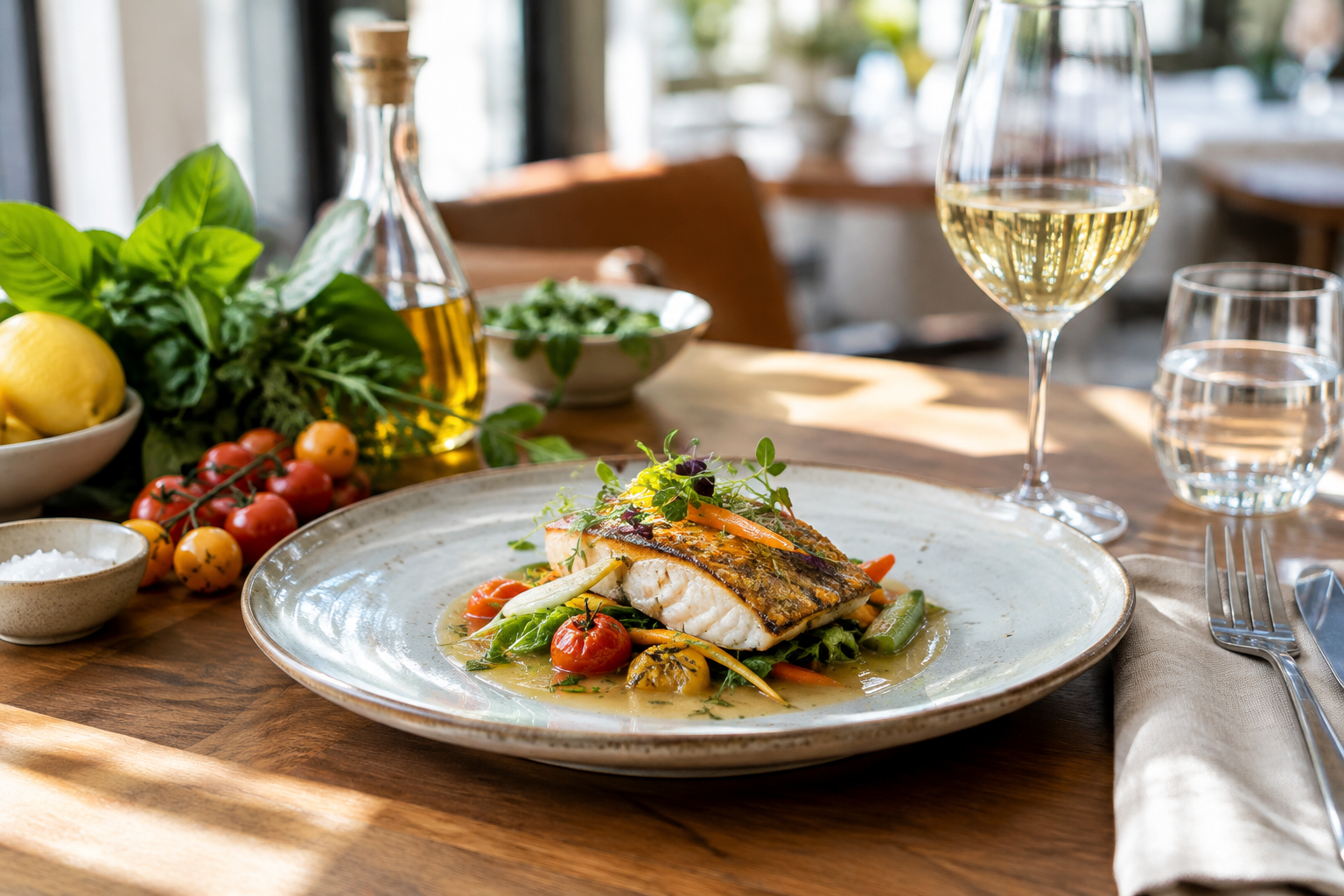
To explore traditional Cuisine Nissarde, start by asking what a menu means by the term rather than relying on the Riviera setting. If you encounter socca, pissaladière or petits farcis, consider asking the person preparing them to explain the ingredients, method and claimed connection to Nice. Keep ingredient descriptions separate from historical claims, and personal preference separate from judgements about authenticity.
This guide offers a practical tasting method rather than a definitive recipe or documented culinary history. Use it to investigate ingredients and traditions without treating an attractive terrace, a familiar dish name or a confident menu description as proof. You do not need to become a culinary historian before lunch. Begin with a few precise questions and give yourself room to compare.
What makes Cuisine Nissarde distinct? Questions to begin with
Rather than look for an ingredient that supposedly belongs exclusively to Nice, investigate combinations, techniques and the explanations attached to them. Ask your host which preparations they consider local, what distinguishes their version and where you could read more about its background.
Keep three questions separate:
- Is this preparation being presented as part of the Niçois repertoire?
- How has this particular cook interpreted it?
- Is the surrounding Riviera imagery influencing your expectations more than the food?
A useful working rule is to assess culinary identity through ingredients, preparation and documented context, not through décor. Enjoy a sea view if it appeals, but do not use it as your test of local heritage. Equally, avoid dismissing a contemporary dining room before asking about the cooking.
For a wider reading break, browse the Lifestyle pages. Keep that browsing separate from the evidence you gather about an individual dish.
Ask what “traditional” means in this conversation
When someone describes a recipe as traditional, invite a specific explanation. Do they mean a family preparation, a published recipe, a remembered method or a version associated with a particular cook? Record the answer as that person's account rather than immediately expanding it into a claim about the whole city.
If the history matters to you, ask for a traceable reference. Without one, leave the historical conclusion open. You can still describe what you ate, what you were told and what you would like to investigate next.
Socca: investigate ingredients, heat and texture
For your first socca, ask the kitchen to describe the mixture. Does this version use chickpea flour? What liquid, oil and seasoning are included? Is anything added that the short menu description does not mention? These questions establish the preparation in front of you without assuming a universal formula.
Then ask how it is cooked. If the cooking area is visible, observe the vessel, the depth of the mixture and the way portions are served. If it is not visible, request a brief explanation rather than inferring the method from the finished surface.
How to approach your first portion
Consider tasting it promptly, before adding extra seasoning. Compare the centre and edge, and note any differences you actually encounter. Do you find crispness, softness, browning or a pronounced flour flavour? Avoid writing those characteristics into your notes before taking a bite.
Useful questions include:
- Was this portion cooked recently?
- What texture does the cook aim for?
- Can you distinguish the main ingredient from the seasoning?
- Which aspects appeal to you, and which would you like to compare elsewhere?
These are tasting prompts, not a certification test. One portion should not become your definition of every socca you might encounter.
For home cooking, choose a complete recipe that explains its ingredients and equipment. Treat batter depth and heat as variables to test, but change one element at a time. Describe substitutions honestly rather than assuming that an altered recipe demonstrates the original preparation.
Pissaladière: look beyond the pizza comparison
Approach pissaladière by requesting an ingredient description before assigning it a familiar category. Ask the cook to describe the preparation in their own terms, then use that explanation to frame any follow-up questions. You might specifically ask whether onions, anchovies or olives are included, without assuming the answer.
If someone compares it with pizza, use that as an opening question rather than a conclusion. Which aspects of the preparation are they comparing? Where do they think the analogy stops being useful? Let the explanation and your observations take priority over the comparison.
Avoid repeating an explanation of the name or its origins unless you have a suitable reference. If a menu mentions pissalat, ask what the term means in that kitchen and whether it describes an ingredient in your order. Keep an ingredient answer distinct from an etymological claim.
What to notice as you eat
If onions are confirmed, consider their texture and seasoning. If anchovies are included, notice how you experience their intensity. If the portion has distinguishable components, consider tasting them separately, then together. Record what you encounter rather than what you think a correct version must taste like.
You might write “soft texture, pronounced saltiness, substantial portion”, provided that describes your order. Add your preference in a separate sentence: “I would like to compare a lighter interpretation.” This preserves the distinction between observation and judgement.
If you avoid fish, ask about the entire preparation before ordering. Do not use the removal of a visible ingredient as your only check. Explain your requirement and ask whether the kitchen can accommodate it; leave the order undecided if the answer remains unclear.
Petits farcis: ask about the whole preparation
With petits farcis, begin by requesting a description of the complete dish being offered. Ask the kitchen to identify its ingredients and explain how they are combined, rather than relying on a short translation or an image. If the description mentions several components, ask whether their ingredients differ.
For dietary requirements, enquire specifically about meat, fish, egg, dairy and bread as relevant to you. If vegetables are mentioned, do not use that information alone to decide whether the preparation fits your needs.
Questions worth asking
At the table, consider:
- What ingredients have been confirmed by the kitchen?
- How easily can you cut each component?
- Do you enjoy the relationship between the components described to you?
- Which flavours remain distinct?
- What would you want to compare in another preparation?
If you find a filling, taste it separately before combining it with the surrounding ingredient. Treat this as an exercise in attention, not an attempt to impose a universal standard. You may prefer a cohesive mouthful, more contrast or a different proportion.
For home cooking, select a complete recipe with explicit preparation and food-safety instructions. Check dietary requirements before shopping and follow appropriate guidance for the ingredients you choose. Keep any changes in your notes so that guests understand what you have made and you can repeat the experiment accurately.
A practical comparison for choosing what to order
Use this table to plan questions, not to rank authenticity. Its purpose is to help you obtain information about the version available to you. The prompts deliberately leave the ingredient answers to the kitchen.
| Dish to investigate | Ingredient questions | Preparation questions | Tasting exercise | Decision before ordering |
|---|---|---|---|---|
| Socca | What is the complete ingredient list for this version? | How is this version cooked and served? | Compare centre and edge before adding seasoning | Does the confirmed ingredient list meet your needs? |
| Pissaladière | What ingredients are used, including seasonings? | How does the cook describe the preparation? | Compare any distinguishable components, then taste them together | Are you comfortable with the confirmed ingredients and portion? |
| Petits farcis | What ingredients are included in the complete dish? | How are those ingredients combined and cooked? | Compare the components identified by the kitchen | Has the kitchen clarified every relevant dietary requirement? |
Choose according to the answer you most want to explore. You might begin with a question about texture, an ingredient you enjoy or a preparation you would like to cook at home. There is no need to order everything in one sitting.
A step-by-step method for exploring the repertoire
Step 1: choose one culinary question
Begin with something manageable: “What ingredients does this kitchen use for socca?” or “How is this pissaladière prepared?” A specific question gives your first stop a purpose without turning lunch into an examination.
Step 2: read beyond the dish name
Look for ingredients, preparation and portion format. If the description is unclear, ask a short question. Consider “Could you describe all the ingredients in this version?” rather than asking whether something is “really authentic”. Keep the request focused on information you need to choose your meal.
Step 3: order for a meaningful comparison
Consider sharing, where practical. Ask about portion sizes before deciding how much to order. Choose preparations that let you explore different questions, rather than building an itinerary around the largest possible number of dishes.
Step 4: record observations, not scores
A few words are enough. Separate what you tasted from what you were told, and distinguish both from personal preference. For example, use three headings in your notes: “Observed”, “Explained by the kitchen” and “To verify”.
Step 5: revisit one dish
Try another interpretation before drawing broad conclusions. Compare the same features each time, rather than letting the room or occasion determine your entire judgement. Ask about any differences instead of assuming that one version disproves the other.
For reading between outings, explore the Magazine pages. Keep your tasting record focused on the meals you actually experience.
Two fictional examples: putting the questions to work
A first visit with limited appetite
Imagine Maya, a fictional visitor with one afternoon in Nice. She wants to explore local cooking without planning a succession of large meals. At her first stop, she asks about the socca ingredients and portion size, then decides whether to order.
In this invented scenario, the server describes a chickpea-flour mixture. Maya records that explanation as information about this particular preparation. She tastes the portion before adding seasoning and notes the textures she encounters.
Later, she shares a pissaladière with a companion after checking its ingredients. Rather than deciding which dish is more authentic, they compare their observations with the explanations they received. Maya leaves with a useful set of questions, not a claim to have mastered the cuisine.
A home cook planning a vegetable-centred dinner
Consider Daniel, another fictional example, who wants to explore petits farcis at home. Before choosing a recipe, he asks his guests about dietary requirements. In this scenario, the recipe he initially considers includes ingredients that do not suit everyone.
He selects another recipe, checks its instructions and describes any adaptations clearly. He keeps the recipe's account of tradition separate from his own substitutions. During dinner, he invites guests to compare the components without presenting his meal as the definitive version.
His aim is modest and useful: understand the preparation he has chosen, serve a clearly described meal and identify what he would like to test next.
Errors worth examining before you judge
Mistaking Riviera atmosphere for culinary evidence
Treat yachts, parasols and glamorous dining rooms as setting, not documentation. Enjoy the atmosphere if you wish, but investigate a claim of local heritage through questions and references. Avoid making the opposite assumption that modest surroundings automatically establish authority.
Treating every difference as a mistake
When two preparations differ, ask what changed and why. Do not decide in advance that the difference represents either a loss of tradition or a creative improvement. Describe it first; reserve the larger conclusion until you have evidence.
Assuming a name answers dietary questions
Ask about the complete preparation, including sauces, seasonings and fillings where relevant. For allergies or strict exclusions, explain the requirement clearly and ask about relevant ingredients and handling. Do not treat this guide as confirmation about any individual kitchen.
Turning simplicity into a verdict on effort
Avoid estimating care or skill from the length of an ingredient list. Focus your home experiments on specific tasks, and ask cooks about their methods rather than assuming that a short description means an effortless preparation.
Confusing personal preference with local identity
You may prefer less salt, a softer texture or a different proportion. Keep that preference distinct from claims about an entire tradition. The most useful conclusion may be that you want to ask another question or try another version.
FAQ
Should I treat Cuisine Nissarde and Riviera food as interchangeable labels?
For this exploration, keep them separate. Ask what specifically connects a preparation to Nice instead of accepting coastal imagery as the explanation. Request a reference if you want to make a historical claim beyond the meal itself.
Which dish should I try first?
Choose the preparation whose confirmed ingredients suit your appetite and dietary needs. Then select one question to investigate: texture, the relationship between ingredients, or the cooking method. Let the kitchen's description guide the details of your enquiry.
Can I explore these dishes without eating fish or meat?
Ask about each preparation individually before deciding. Request ingredient confirmation and discuss strict exclusions with the kitchen. If a suitable adaptation is offered, describe it as the version you ate rather than assuming it establishes a general recipe.
How can I form an informed opinion without becoming an expert?
Ask one useful question, taste attentively and distinguish observation from inference. Compare another preparation when possible. You do not need a definitive authenticity verdict to describe a meal thoughtfully.
For your next reading stop, return to the main site. At the table, keep the same principle: investigate what is on the plate, listen carefully to its explanation and leave unsupported conclusions open.