

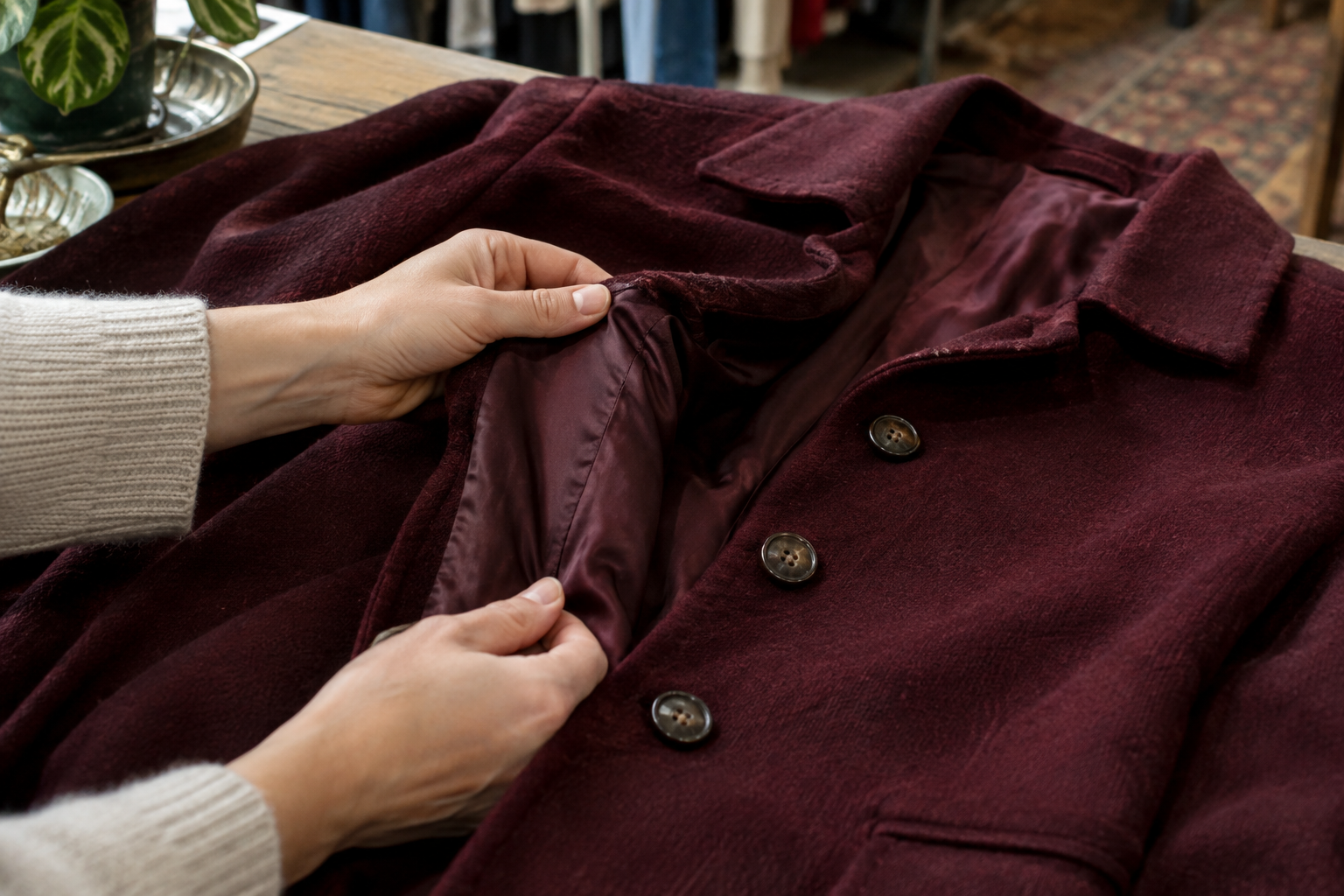
When buying vintage designer fashion in Paris, assess the garment before committing to the name: examine its construction, compare labels with the seller’s description, look for alterations, record condition and ask what supports its provenance. Treat these as separate questions. Do not infer authenticity from beautiful finishing, or let a confirmed attribution replace your assessment of wearability and proposed repairs.
Use your inspection to decide whether to buy, investigate further or walk away—not to manufacture certainty. If the purchase depends on a particular designer attribution, collection date or claim of originality that you cannot substantiate, consider a suitably qualified specialist before paying.
If you want a separate browsing break, visit Magazine, while keeping inspiration separate from evidence about an individual garment.
Start with the purchase you actually want to make
Before entering a shop or arranging a viewing, decide what would make the piece worthwhile to you. Are you buying something to wear regularly, a garment to study, or an attributed design whose significance depends on its history? Those intentions should guide your questions.
For a wearable purchase, prioritise fit, fabric stability and realistic care. For a study piece, you might accept damage but want access to its internal construction. For a collection-led purchase, attribution and documentation may be central.
Write down your non-negotiables. These could include no active odour, no structural repair, enough movement for sitting, or independent assessment before purchase. Set a total spending boundary that includes any proposed cleaning, alterations and specialist review, without assuming those services will solve every problem.
Ask about photography and handling before inspecting. Request permission to turn the garment inside out, examine labels and try closures. Do not pull at fragile fabric or unpick stitching. If access is restricted, record what remains unseen and decide whether you can accept that uncertainty.
Inspect the whole silhouette before the details
Begin with the garment hanging naturally, then inspect it on a body if trying it on is permitted and safe. Look from the front, back and sides before concentrating on the label.
Consider these questions:
- Do the shoulders and sleeves sit as you would want them to?
- Does the centre front hang straight when fastened?
- Are the hem and side seams balanced?
- Does the lining pull against the outer fabric?
- Are there unexpected folds around pockets, armholes or closures?
Do not force every unusual shape into a conventional idea of good fit. Instead, ask whether it appears intentional and whether you can wear it comfortably. A sculptural shoulder or asymmetric hem deserves investigation, not automatic rejection.
If trying the piece on, move gently: sit, reach forward and bend your elbows without stressing it. Ask someone to photograph the back with permission. Avoid deciding that a difficult fit is merely a sizing issue until a tailor has assessed what changing it would involve.
Read construction without treating it as authentication
When the sales description is vague, make construction part of your inspection checklist. Ask to see the inside and compare how different parts of the garment have been assembled.
Seams, hems and internal support
Inspect seam allowances, seam finishes, hem stitching and any visible support at the shoulders, waist or bodice. Look for puckering, strained stitches, loose threads and fabric pulling away from a seam. Compare corresponding areas on both sides.
Treat a difference as a question rather than a verdict. If one sleeve has a different seam finish, ask whether it was repaired or altered. If a hem contains several lines of old needle marks, note them for further assessment.
Do not use hand stitching, generous seam allowances or a substantial lining as standalone proof of designer origin. Assess the construction on its own terms, then investigate attribution separately.
Closures, pockets and decorative details
With permission, test each zip, button, hook and snap gently. Check the surrounding fabric rather than merely confirming that the fastening works. Examine pocket corners, buttonholes, belt loops and the attachment points of bows, beads or other embellishment.
Ask whether any component has been replaced. A replacement closure may be acceptable for your intended use, but do not silently treat it as original. Photograph distinctive details and any discrepancies the seller agrees to discuss.
Assess labels as evidence, not a final answer
Record every label you can access: designer, retailer, size, care and composition labels, along with any handwritten marks. Photograph the reverse where accessible without disturbing the stitching.
Transcribe the wording exactly. Avoid correcting unfamiliar spelling, abbreviations or addresses from memory. Note where each label sits and how it is attached. If the description gives a precise period, ask what evidence connects that period to this particular piece.
Useful questions include:
- Is the attribution based only on the main label?
- Are there references showing a comparable garment?
- Does the proposed comparison include the same cut and details?
- Is any dating approximate, and how was that estimate reached?
- Has someone assessed whether the labels belong to this garment?
Do not turn one online image into a definitive comparison. If you find a similar logo or label layout, record the resemblance and ask what further evidence supports the attribution rather than making an authentication decision from that comparison alone.
Where labels are missing, ask the seller to distinguish observation from inference. “Attributed to” should prompt a discussion about the basis and limits of that attribution. If your willingness to buy depends on a named designer, give unresolved labelling questions particular scrutiny.
Look for alterations and decide which matter
Ask directly whether the piece has been shortened, taken in, let out, relined or otherwise changed. Then inspect the areas relevant to those answers.
Look around hems, side seams, waistbands, shoulders and cuffs for old stitch lines, differing thread, irregular allowances or interrupted patterns. Compare the lining with the outer garment. At a hem or cuff, ask about any visible difference in colour or wear between folded and exposed sections.
Avoid declaring an alteration from one clue alone. Record what you see and, where necessary, ask a tailor or specialist to interpret it.
Separate three decisions:
- Can you wear it as it is? Judge comfort and movement rather than the size label.
- Would you accept its existing changes? Consider whether they affect the shape or details you wanted.
- Would you authorise further work? Obtain an assessment before assuming a change is straightforward.
Ask the proposed repairer to explain what would be removed, replaced or left visible. For a purchase motivated by historical interest, consider whether you would prefer to leave an imperfect garment unchanged.
Make a condition map, not a vague judgement
Replace “good vintage condition” with a location-by-location record. Inspect in useful light, without rubbing, scraping or applying products. Ask permission before moving the garment towards a window.
Work through the neckline, underarms, cuffs, elbows, waistband, seat and hem. Then examine the lining, pockets, closures and decorative elements. Record holes, thinning, stains, fading, loose stitching and missing components separately.
Fabric and surface
Look for areas that appear unusually thin, stiff, powdery, sticky or distorted. If you are concerned about fragility, stop handling and seek advice rather than testing strength by pulling. Examine folds and attachment points without stretching them.
Stains and odour
Describe what you notice without diagnosing its cause. Record the location and extent of a stain; do not assume it will disappear in cleaning. Ask about any cleaning already attempted and whether the seller has documentation of treatment.
If odour is unacceptable to you, avoid purchasing on the assumption that airing or cleaning will resolve it. Seek a cleaner’s assessment if the purchase otherwise remains attractive.
Repairs
Ask what has been repaired, by whom if known, and whether images show the garment before treatment. Decide whether visible mending suits your intended use. Do not describe a repair as reversible unless an appropriately qualified person has assessed that specific work.
Use provenance to test the story
Treat provenance as a set of records to examine, not an atmosphere created by a convincing sales narrative. Ask which parts of the history are documented and which rely on recollection.
Possible material to request includes an earlier invoice, dated photographs, correspondence or a previous condition report. Examine whether each item identifies this particular garment rather than merely a similar design. Request that irrelevant personal information be concealed where appropriate.
Keep several questions separate: who owned it, who made it, when it was made, and what has happened to it since. Do not automatically treat evidence addressing one question as resolving the others.
Ask for the seller’s description and any material qualifications in writing. If the story becomes less precise under questioning, pause rather than filling the gaps yourself. You can choose a garment without endorsing an unsupported history, provided that history is not essential to your decision.
Compare the purchase routes practically
Use this table during a viewing. Treat it as a decision aid, not a scoring system for authentication.
| Decision area | Question to ask | Reason to pause | Next step to consider |
|---|---|---|---|
| Fit | Can I move comfortably without forcing it? | Pulling, restriction or an unclear alteration plan | Ask a tailor to assess the proposed work |
| Construction | What explains the differences I can see? | Unexplained changes between corresponding sections | Request closer inspection and repair history |
| Labels | What supports the stated attribution? | The label is the only evidence offered | Seek an independent specialist opinion |
| Condition | Can I accept the defects as they are? | Purchase depends on a stain or odour disappearing | Obtain a cleaning or conservation assessment |
| Alterations | Which details have changed? | The original shape is central to your interest | Compare documentation and seek specialist advice |
| Provenance | Do the records identify this piece? | A detailed story lacks a clear documentary connection | Request supporting material before deciding |
| Terms | What is agreed if I need further assessment? | Important terms remain verbal or unclear | Request written clarification before payment |
For a change of subject between viewings, consider browsing Lifestyle. Keep practical purchase checks on your own written list rather than relying on the momentum of a shopping day.
Know when specialist authentication is needed
Consider specialist assessment when the value you attach to the purchase depends substantially on authorship, period, collection attribution or originality. Other reasons to pause include inconsistent labels, unexplained construction changes or a seller’s claim that you cannot independently evaluate.
Choose expertise relevant to the garment and the question. Ask what the assessor examines, what materials they need, and whether their conclusion covers attribution, dating, alterations or condition. Do not assume those are interchangeable services.
Before commissioning an assessment, clarify:
- Whether examination is in person or image-based.
- What limitations will be stated in the report.
- Whether the assessor is independent of the sale.
- Whether an inconclusive result is possible.
- What documentation you will receive.
Frame your requests separately: ask the tailor to assess fit and proposed alterations, the attribution specialist to examine authorship, and the cleaner to assess any proposed treatment. Ask each person to specify which questions they can address and which remain outside their assessment.
Three fictional purchase decisions
The following examples are fictional and illustrate decision-making, not actual stock or documented transactions.
A jacket with a persuasive label
You find a jacket whose label matches the seller’s description, but one sleeve lining differs from the other. You ask about repairs and receive no clear history. Rather than declaring it false or genuine, you request photographs and an independent assessment. If attribution is central to the purchase and assessment is unavailable, you leave it.
A dress that almost fits
You like a dress, but the waist is tight and the hem shows previous stitching. You ask a tailor to examine the available allowances before agreeing to buy. If the proposed work would remove a detail you particularly want, you reconsider rather than treating alteration as an automatic solution.
An unattributed coat with visible wear
You want an everyday coat, not a collectible. You inspect its fit and record worn cuffs and a lining tear. You ask for a repair assessment and decide whether you would still enjoy it with those imperfections. You do not need to invent a designer history to justify your preference.
Errors to examine before paying
Check whether excitement has replaced an unanswered question. Have you mistaken weight for quality, a familiar label for authentication, or a confident story for documentation? Have you dismissed every irregularity as damage—or explained every irregularity away as intentional design?
Avoid mentally pricing a repair before someone has assessed it. Equally, do not let a hypothetical future resale determine whether the garment meets your present needs.
Before payment, review the written description, visible defects, agreed terms and any unresolved questions. Keep permitted photographs and supporting records together. If you cannot explain why the piece suits your purpose without repeating the seller’s adjectives, take more time.
If you wish to continue browsing after your inspection, return to the homepage; use the garment’s own evidence, not surrounding inspiration, to make the purchase decision.
FAQ
Can I authenticate a designer garment from its label alone?
Do not rely on the label alone. Ask how it relates to the garment’s construction, accompanying records and stated attribution. Seek specialist assessment if designer identity is essential to your purchase.
Should I reject a piece because it has been altered?
Not automatically. Decide whether the changes suit your intended use and whether they affect details important to you. Ask for clarification where the extent of alteration is uncertain.
What should I do if a seller promises a stain will clean out?
Request an assessment from an appropriate cleaner before relying on that outcome. Alternatively, decide whether you would accept the garment with the stain unchanged.
When is walking away the sensible choice?
Consider leaving when you cannot inspect important areas, essential claims remain unsupported, or the purchase depends on repairs nobody has assessed. You do not need to prove that a garment is wrong to decide it is not right for you.