

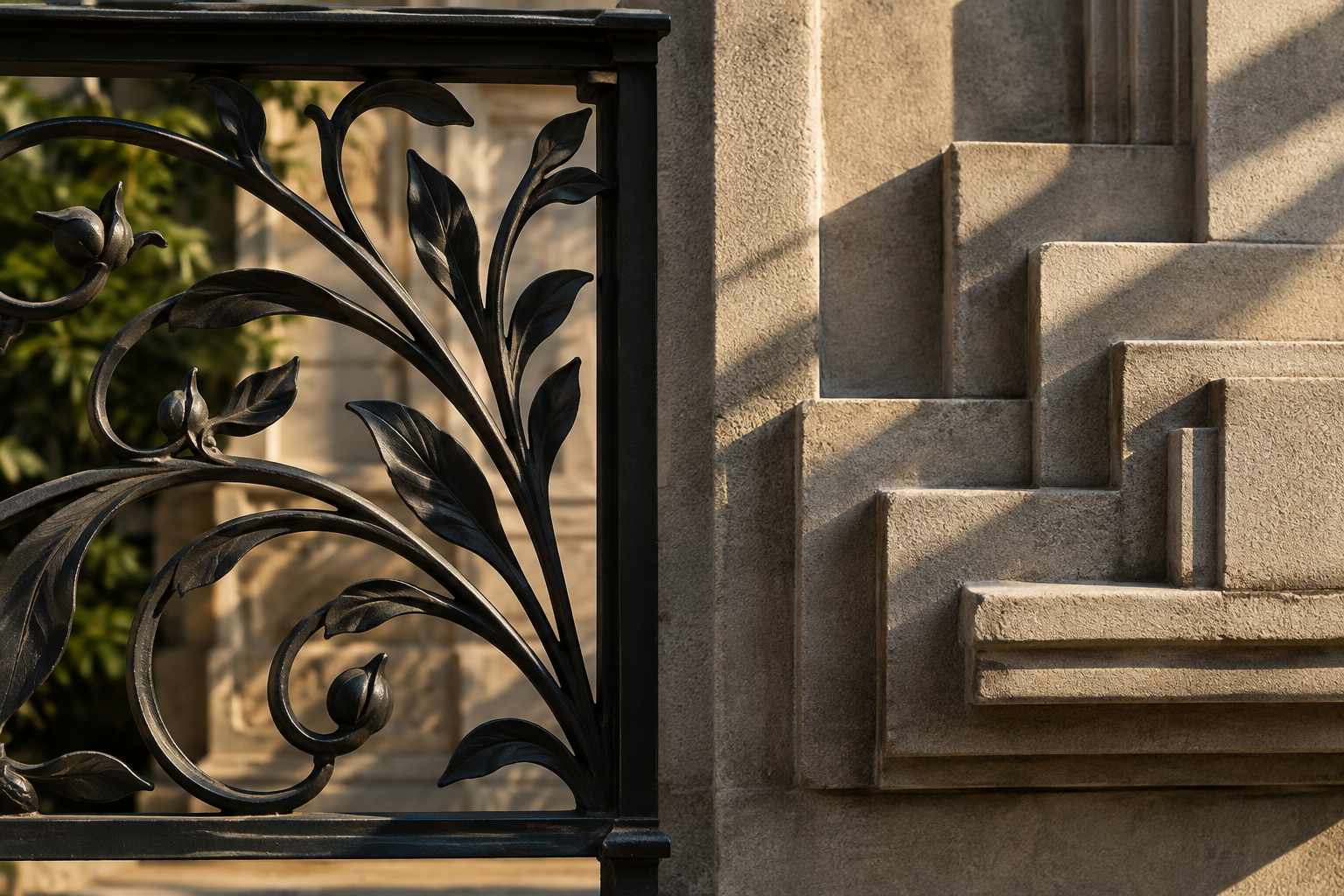
To distinguish Art Nouveau from Art Deco in Paris, start with the building’s overall composition, then examine its ornament—and check your interpretation against building-specific documentation. For your walk, try comparing two visual possibilities: flowing, organic movement and a more explicitly geometric organisation. Treat these as questions to investigate, not definitions that automatically settle a building’s style.
The practical approach is to separate what you can see from what needs verification. You can describe a branching railing, a repeated window pattern or a deeply modelled entrance without claiming to know its architect, date or classification. Reserve those historical conclusions for a reliable architectural record.
For an Art Nouveau vs Art Deco Paris exploration, this guide keeps four names on your research list: Castel Béranger, the Lavirotte building, the Palais de la Porte Dorée and the Palais de Chaillot. Their individual histories and stylistic classifications are not established by the documentation available here. Use the questions below to prepare your observations, rather than treating the names as a verified itinerary or a definitive comparison.
Start with the whole facade, not its prettiest detail
Before approaching a doorway, look from the opposite pavement wherever there is a safe place to stand. Notice the roofline, the spacing of windows and the relationship between the centre and the sides.
Does the composition appear restless and varied, or balanced and controlled? Does decoration seem to change the shape of openings, or sit within a stable architectural grid?
Keep your initial description neutral. Instead of writing “an unmistakable Art Nouveau entrance”, try “an entrance with irregular curves continuing into the surrounding frame”. Instead of “a typical Art Deco elevation”, record the repeated shapes that prompted that impression.
Try separating your observations into three levels:
- Composition: symmetry, rhythm, silhouette and the arrangement of openings.
- Materials: apparent surface types, textures and the way they meet.
- Ornament: plants, figures, lines and repeated motifs.
Aim to build an argument from several observations. If they point in different directions, keep the identification provisional. Your notebook should make it possible to revisit the conclusion without losing the details that first interested you.
Investigate an Art Nouveau reading through line and movement
When considering an Art Nouveau interpretation, try following a line across the entrance rather than counting floral motifs. Does it branch, tighten, curl or change direction? Does the surrounding frame echo it? Record the answers before applying a label.
This is a looking exercise, not a documented definition of the style. Its purpose is to give you specific features to compare with a trustworthy description of the building later.
Castel Béranger: prepare an entrance study
For a prospective visit to Castel Béranger, first verify the location and find a building-specific record. Check what that record actually identifies: the entire building, its entrance, particular materials or individual decorative elements.
On site, choose one visible junction to study. If metalwork meets masonry, trace the boundary between them. Does each component appear visually independent, or do their outlines respond to one another? Avoid assuming that a visual relationship establishes shared authorship or a construction date.
Make one wide observation and one close observation. Together, these will give you something concrete to compare with the documentary description.
The Lavirotte building: separate observation from material identification
Use the same preparation for the Lavirotte building. Confirm its address and documentary identity before planning the stop; do not infer either from a photograph caption alone.
If you encounter a glossy, coloured or sculpted surface, describe its visible qualities first. Note sheen, texture, joints and relief depth. Leave the precise material name open unless you can substantiate it.
Ask how ornament relates to an opening. Does it remain within a border, overlap adjoining areas or become difficult to separate from the frame? These are useful observations to record without turning them into unsupported claims about this particular building.
Investigate an Art Deco reading through repetition and framing
When considering an Art Deco interpretation, try mapping the facade’s repeated elements. Mark the principal verticals, horizontal divisions and outlines of openings in a quick sketch. Then ask where decoration sits in relation to that framework.
Keep the hypothesis explicit: “I want to check whether this organisation supports an Art Deco classification.” Avoid quietly replacing that question with “geometric means Art Deco”.
Palais de la Porte Dorée: prepare a surface-and-framework comparison
Before visiting the Palais de la Porte Dorée, seek documentation that identifies the building and explains the features you intend to examine. Distinguish a source’s stylistic description from its discussion of imagery or historical context.
For your observation exercise, select a visible decorated area, if available, and compare it with the larger elevation. Ask where its boundaries begin and end. Does your eye follow the decoration or the architectural divisions first?
Keep stylistic observation separate from interpretation of imagery. If you cannot establish what a figure or scene represents, write a question rather than supplying a narrative.
Palais de Chaillot: test the limits of a label
For the Palais de Chaillot, prepare a study of composition without deciding the classification in advance. Verify which part of the site your source describes, and match that scope to your notes.
Try comparing a distant view with a smaller visible section. What disappears when you move closer? What becomes legible only at a distance?
If your eventual sources use different architectural terms, preserve that distinction in your notes. Do not force every reference into a two-column Art Nouveau–Art Deco choice simply because that was the starting question of your walk.
A practical comparison table
Use this table as a worksheet, not an identification key. Its two observation columns suggest alternatives to examine; neither assigns a feature exclusively to a style.
| Criterion | First possibility to examine | Contrasting possibility to examine | Question for your research |
|---|---|---|---|
| Composition | Varied outlines or uneven emphasis | Strong axes and repeated bays | How does a building-specific record describe the arrangement? |
| Line | Branching or irregular curves | Angular or regularly repeated lines | Which details support the proposed classification? |
| Plant ornament | Motifs extending across a frame | Motifs contained within repeated units | Does the source discuss their treatment? |
| Metalwork | Changing shapes between sections | Repeated modules | Is the element documented separately? |
| Surface | Pronounced modelling and texture changes | Panels, borders or bands | What materials are actually identified? |
| Openings | Individually shaped frames | A consistent sequence of outlines | Does the entrance agree with the upper elevation? |
| Uncertainty | An isolated organic feature | An isolated geometric feature | What evidence would change your first impression? |
For materials, keep two notebook columns: “visible description” and “verified identification”. Put “glossy green surface” in the first; add a specific material to the second only when you have evidence. This avoids presenting an attractive guess as a technical finding.
A step-by-step method for your own architecture walk
Choose a small number of stops rather than trying to classify every building you pass. Confirm locations and the travel between them before setting out. Treat the four research candidates above as separate possibilities until you have checked your route.
1. Establish a safe viewing position
Find a place where you can pause without blocking an entrance or stepping into traffic. Do not rely on crossing the road simply to improve a photograph. If parked vehicles obscure the base, start with the upper floors.
2. Write a neutral first description
Before naming a style, record what you see: “three repeated window bays”, “curved iron stems” or “relief contained within a rectangular panel”. Avoid words such as elegant or futuristic at this stage; they describe a response more than an architectural feature.
3. Compare the entrance with the upper storeys
Ask whether the same visual language continues above ground level. If you notice a mismatch, record it without inventing an explanation. Put questions about replacement, alteration or different authorship on your research list rather than in your description of established history.
4. Examine two surfaces together
Choose a junction: a railing against a frame, a coloured surface beside a plain one, or ornament around a window. Look for continuity or contrast. This keeps the exercise focused on relationships rather than a collection of attractive details.
5. Make a provisional identification
Write “possible Art Nouveau reading”, “possible Art Deco reading” or “classification unresolved”, followed by your observations. Keep that entry separate from a later, source-supported classification.
6. Record the unresolved question
Perhaps the facade looks geometric but its balconies seem unusually fluid. Perhaps the composition resists a simple label. Keeping one question is preferable to forcing certainty.
For a browsing break between walks, consider visiting Magazine. Keep this optional reading separate from your search for building-specific documentation.
Two fictional street-side exercises
The following scenarios are invented learning examples, not descriptions of additional Paris addresses. They illustrate a method of questioning; neither establishes a stylistic rule.
Fictional example: a floral railing that tempts a quick verdict
Imagine a facade with regularly spaced windows, a central axis and balcony railings containing roses. Your first instinct is to write “Art Nouveau” because the ornament is botanical.
Now describe the design more carefully. In this fictional example, each rose sits inside an identical angular compartment, and the doorway repeats the same framework. Record both the botanical subject and the geometric arrangement.
Rather than changing immediately to an Art Deco verdict, formulate a research question: “How does the building’s documentation classify this combination?” Your next step is to check its history, not to turn the exercise into proof.
Fictional example: an understated entrance with branching lines
Imagine a relatively plain upper facade above a doorway whose metal lines branch unevenly. The frame changes contour around them, and adjacent ornament follows the same movement.
You might investigate an Art Nouveau reading, but keep the conclusion open. Describe the relationship between frame, metal and surface, then ask whether a reliable record discusses those same features.
For another optional reading break, consider browsing Lifestyle. Keep your actual walking plan selective enough to allow unhurried stops.
Common mistakes worth examining
Turning one curve into a classification. Before assigning a style, explain which additional observations you would want to check. Try describing the curve’s position and relationship to neighbouring elements.
Treating plainness as a verdict. If a facade has little visible ornament, concentrate on its proportions and divisions. Leave its classification open until you have documentary support.
Guessing materials from colour. Record colour as colour. If the material matters to your interpretation, make identifying it a separate research task.
Confusing a detail with the entire building. State the scope of your observation. A note about a railing should not silently become a conclusion about every part of the elevation.
Inventing a construction history from visible differences. Save questions about alterations for documentary research. Avoid supplying dates or explanations simply because two surfaces look different.
Ignoring ordinary upper floors. Give the window spacing and repeated divisions the same attention as the entrance. Ask whether your initial interpretation still makes sense when you consider the whole visible elevation.
For further browsing, consider visiting Lookbook. Keep a separate note of any building questions you want to verify later.
FAQ
Should I use symmetry to decide between Art Nouveau and Art Deco?
Use it as an observation to investigate, not a verdict. Sketch the main axis and note any departures from it. Then check whether a building-specific source connects those features to its classification.
How should I assess flowers or luxurious-looking materials?
Describe the treatment of the motif and the visible surface without guessing cost or provenance. Ask whether the decoration branches, repeats, crosses a frame or stays within a panel. Verify the historical interpretation separately.
Which of the named buildings should I compare first?
Choose the pair for which you can first obtain clear, building-specific documentation and confirm a practical route. Castel Béranger and the Palais de la Porte Dorée remain possible research candidates, not a verified stylistic pairing established here.
What if I still cannot decide?
Keep the description and postpone the label. Note the address, visible features and point of uncertainty, then seek a building-specific heritage or architectural record. Make attentive looking your aim, rather than a confident label for every facade.