
To read Paris couture craftsmanship critically, ask what each term explains about the garment in front of you. When you encounter toile, ask what was tested; for flou, ask how the fabric was handled; for tailoring, ask how the shape was constructed; and for hand-finishing, ask precisely which operation was performed by hand. Use these as questions to investigate, not as automatic assurances of quality.
Connect the vocabulary to something specific: a trial sleeve, a controlled fold, an identified support or a finished edge. Rather than accepting “exquisite craftsmanship” as an explanation, look for an account of what was adjusted, constructed or sewn.
Read “inside” here as an invitation to examine the language of making, not as a claim of access to a particular workshop. Use this guide as a practical reading method rather than a definitive technical glossary. Where a description leaves a gap, treat that gap as a question—not permission to imagine what happened behind the seams.
Start with the garment, not the adjective
Begin with the object. Is it a jacket, a fluid dress or a garment combining both? Where does it appear to hold a shape? Where would you want to examine movement? Which parts touch the body, and which stand away from it?
Then separate three kinds of statement in your notes:
- A process statement to verify: a trial garment was adjusted at the shoulder.
- A construction statement to verify: an internal layer supports a shaped area.
- An evaluation to examine: the garment is exceptional, timeless or perfect.
For the first two, seek evidence identifying the garment and the operation. For the third, ask for criteria. What does “exceptional” refer to: a construction problem, a carefully resolved junction or simply the writer’s response?
Keep this distinction in mind when browsing the Magazine section: separate description, evidence and interpretation in your own reading. Do not assume that an evocative account is intended as a complete technical explanation.
Before examining details, decide what you want to learn. Reading for visual pleasure, researching a technique and considering a purchase call for different questions. Choose the level of scrutiny that fits your purpose.
Toile: ask what was being tested
When a document uses *toile*, look for its explanation of the term and the purpose of the object shown. Does the account identify a trial version, a fitting stage or another use? Record the document’s meaning rather than supplying a definition it has not given.
If the account describes a trial garment, ask which decisions were under examination. Consider proportion, volume, sleeve position and the relationship between pieces as possible subjects for inquiry—not as established purposes of that particular trial.
What to look for in documentation
Look for marks and interventions rather than concentrating only on an immaculate surface. If an image includes pins, drawn lines or altered sections, ask whether the accompanying text explains them.
Useful questions include:
- What was this version intended to test?
- Which areas were altered between versions?
- How was the trial material selected?
- Which decisions remained unresolved at this stage?
Pay particular attention to the relationship between trial and final materials. Ask whether the author explains which aspects of the eventual garment the trial was meant to represent. Avoid assuming that a photographed pale garment answers every question about the finished design.
If the word appears in a fabric description rather than a fitting account, check its intended meaning before importing conclusions from another context. Keep your notes tied to the use being documented.
Finally, avoid treating the existence of a trial as a verdict on the final result. Seek the subsequent decision: what changed, what stayed and why?
Flou: investigate how softness is handled
When *flou* appears in an atelier account, ask how the writer defines it. Look for an explanation connected to a garment or operation rather than treating the word itself as a technical demonstration.
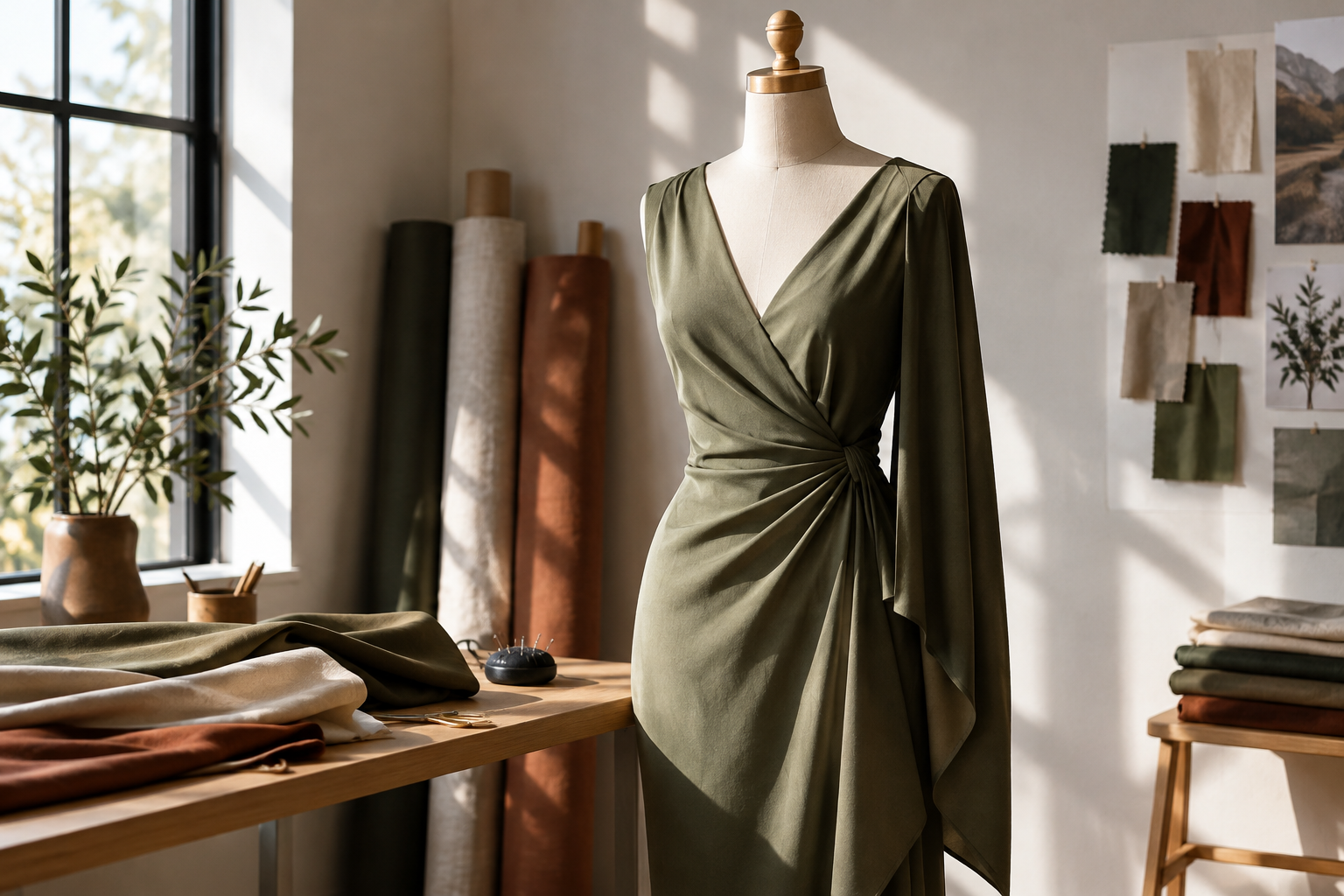
For a softly falling dress, try following the fabric from an apparent point of support. Does a fold begin near the shoulder, waist or neckline? Does fullness enter a seam? Where would you ask for a closer view?
Keep those observations separate from explanations of how the effect was achieved. Write “a fold appears to begin at the shoulder” rather than assigning an unseen attachment method.
Read the fold, then ask about its support
Use an exterior image to formulate a question: “What controls this fold?” If the documentation supplies an answer, check that it concerns the same garment and area.
For close reading, consider:
- Which folds you would ask the maker to explain.
- How openings and closures relate to the draped area.
- Whether a sheer section warrants a question about coverage.
- What additional information a movement sequence might provide.
These are prompts for examination, not a universal checklist for beauty. Before judging asymmetry or exposed construction as a fault, ask whether the account identifies an intended effect.
For a personal fitting, translate visual curiosity into a practical request: ask to see how the relevant section behaves while you sit, turn or raise your arms. Judge the response against your needs rather than against the word *flou* alone.
Tailoring: ask how the shape was constructed
When a description uses *tailoring*, look for the operations it actually identifies. Ask about cutting, shaping, pressing, internal materials and lining where those subjects are relevant to the garment. Do not turn this list of questions into a claim that every listed operation was used.
Treat “architectural” and “sculpted” as invitations to investigate the shape. Ask the writer or maker to connect the description to a specific feature before accepting it as a construction explanation.
Examine junctions, not just silhouettes
Choose a few junctions for closer study: a collar meeting a lapel, a sleeve joining the body or a pocket interrupting a shaped panel. Request a view suited to the question rather than drawing a detailed conclusion from an overall image.
If documentation includes an interior view, relate it to the exterior. Ask what each identified element is intended to do. Label your own guesses as guesses, and leave unnamed layers unnamed.
Also avoid forcing the whole garment into one category. For a design with a firm-looking upper section and a fluid-looking skirt, examine each area separately. Ask how the transition was resolved instead of deciding that one label must explain everything.
If considering a garment for yourself, prioritise questions about movement, comfort and possible alterations. Establish what matters to your use before assessing a technical description as a reason to buy.
Hand-finishing: name the operation before judging it
Read “hand-finished” as a prompt for clarification. Ask which detail, which operation and which part of the garment the statement covers. Do not extend it beyond the scope supported by the description.
Keep three questions separate:
- Which operation was performed?
- Does the documentation identify handwork, machine work or a combination?
- What effect was sought at that location?
If a close photograph accompanies the claim, check whether the caption identifies the photographed area. Limit your notes to that area unless additional documentation supports a broader statement.
Avoid ranking handwork above machine work without first considering the task. When assessing a finish, ask about its suitability for the fabric, appearance, flexibility and accessibility for future alteration or repair.
Words that need a follow-up question
Preserve the exact wording of labels such as “hand-sewn,” “hand-embroidered,” “hand-applied” and “hand-finished” in your notes. Ask what each label covers rather than treating them as interchangeable.
If a caption mentions an embellishment applied by hand, ask whether it describes the attachment, the creation of the embellishment or both. If it mentions a lining, keep your conclusion about that lining; seek separate evidence for other details.
The aim is not to diminish the work. Aim instead for an explanation precise enough to discuss the skill without relying on a blanket compliment.
A practical comparison of the four terms
Use this table when reading a feature, watching a workshop film or preparing questions. Treat it as a research plan, not a set of verified definitions or a scoring system.
| Term encountered | Starting question | Material to request or examine | Decision question | Conclusion to withhold |
|---|---|---|---|---|
| Toile | What does this document mean by the term? | An identified trial and an account of revisions | What was learned or changed? | That the final fit is successful |
| Flou | Which handling of fabric is being described? | Relevant details, attachments and movement views | Is the explanation specific to this garment? | That a soft appearance establishes a method |
| Tailoring | Which construction operations are identified? | Relevant junctions and explained interior views | How does the described shape meet my needs? | That the silhouette proves an unseen technique |
| Hand-finishing | Which operation was manual? | A named detail and corresponding documentation | Does this detail matter to my assessment? | That the entire garment was made by hand |
After using the table, underline any unanswered question that matters to your decision. You need not resolve every technical point. Concentrate on the information necessary for the conclusion you want to draw.
How to read published atelier documentation, step by step
1. Establish what kind of document you have
Identify whether you are reading an editorial feature, a caption, a technical explanation or a promotional text. Consider its stated purpose before deciding what you expect it to demonstrate.
Note whether the text discusses a named garment, a general practice or an illustrative scene. Do not turn a general explanation into a claim about a specific piece.
2. Extract the actual operations
Write down verbs before adjectives: cut, pin, baste, shape, press, attach, embroider, finish. Then note what each operation acts upon and whether the author identifies who performed it.
For a statement such as “an edge was finished by hand,” ask which edge and how. Preserve the limits of the answer rather than completing it from expectation.
3. Match words to images carefully
Ask whether the image shows the operation described or merely accompanies it. Check the caption before connecting a photographed tool or work surface to a garment elsewhere in the feature.
If the connection is unclear, record it as unclear. Do not bridge the gap through visual resemblance alone.
4. Follow the sequence where possible
Try arranging the documented stages under development, fitting, construction and finishing. Leave blank spaces where the account provides no information.
Use the resulting outline to decide whether you have an explanation of one operation or a broader account of making. Choose your conclusion accordingly.
5. Turn missing information into useful questions
For a fitting or viewing, select a few questions relevant to your interests: Can this area be altered? What supports this shape? What care instructions apply to this finish?
Avoid demanding an exhaustive technical explanation when a practical answer would serve you better. For a change of reading pace, consider the Lifestyle section, keeping the same habit of distinguishing observation from inference.
Two fictional cases: putting the vocabulary to work
Fictional case one: the apparently effortless dress
Imagine a fictional feature showing a fluid evening dress, a pinned trial bodice and an interior waist attachment. Its caption calls the result “effortless.” These details are invented for this exercise.
Start with the feature’s stated evidence. Record the trial bodice and attachment separately, then ask how either relates to the drape. Do not assign a function to the attachment merely because it appears beside the dress.
A careful reading might ask: “What changed after the trial, and how does the outer fabric relate to the waist attachment?” Withhold a claim such as “every fold is hand-sculpted” unless the account actually documents it.
If choosing this fictional dress for an occasion, add your own criteria: seated comfort, coverage during movement and the clarity of care advice.
Fictional case two: the jacket with a hand-finished claim
Imagine a fictional jacket description saying “hand-finished,” accompanied by stitching photographed inside the hem. An exterior view shows a pronounced shoulder and shaped waist. Again, this is an invented example.
Separate the questions. Ask whether the hem image illustrates the stated hand-finishing. Then request an independent explanation of the shoulder if its construction matters to you.
For a purchase decision, ask about comfort, movement, alterations and care. Do not make your judgment depend on a broader handmade claim than the fictional description supplies.
Errors worth examining before you draw a conclusion
Check whether you have allowed one detail to stand for an entire garment. Keep an account of a hand-worked edge, embellishment or fitting within its documented scope.
Next, review any conclusion drawn from a workshop film. Identify the exact sequence supporting it; omit explanations of stages the film does not establish.
Also examine these shortcuts in your own notes:
- Using an asserted amount of labour as your entire quality assessment.
- Assuming an invisible finish is preferable without considering the design.
- Labelling a feature faulty before asking about its intention.
- Inferring comfort or durability from appearance alone.
- Treating “couture” as a substitute for detail about the garment.
For your next reading session, choose one garment and write a short account using only documented operations and clearly identified observations. Put your interpretation in a separate paragraph. If continuing from the homepage, carry that two-part note-taking method into your next article.
FAQ
Is a toile the same as a pattern?
Ask the document to identify each item and explain its role. If it distinguishes a pattern from an assembled trial, preserve that distinction in your notes. Without a technical source, avoid supplying a definitive glossary entry on its behalf.
Does flou mean that a dress has no structure?
Do not infer an absence of support from the label. Ask how the source uses the term and seek an explanation of any relevant attachments or interior elements before reaching a conclusion.
Does hand-finishing mean a garment is entirely handmade?
Require an explicit statement of scope before drawing that conclusion. If the documentation concerns only a hem, keep your assessment about that hem and ask separately about seams, closures and internal construction.
Can photographs alone establish craftsmanship quality?
Use photographs to identify questions rather than to settle every issue. Decide which additional evidence you would want for fit, movement, handling or interior construction. Keep the final assessment proportionate to what you can actually examine.