

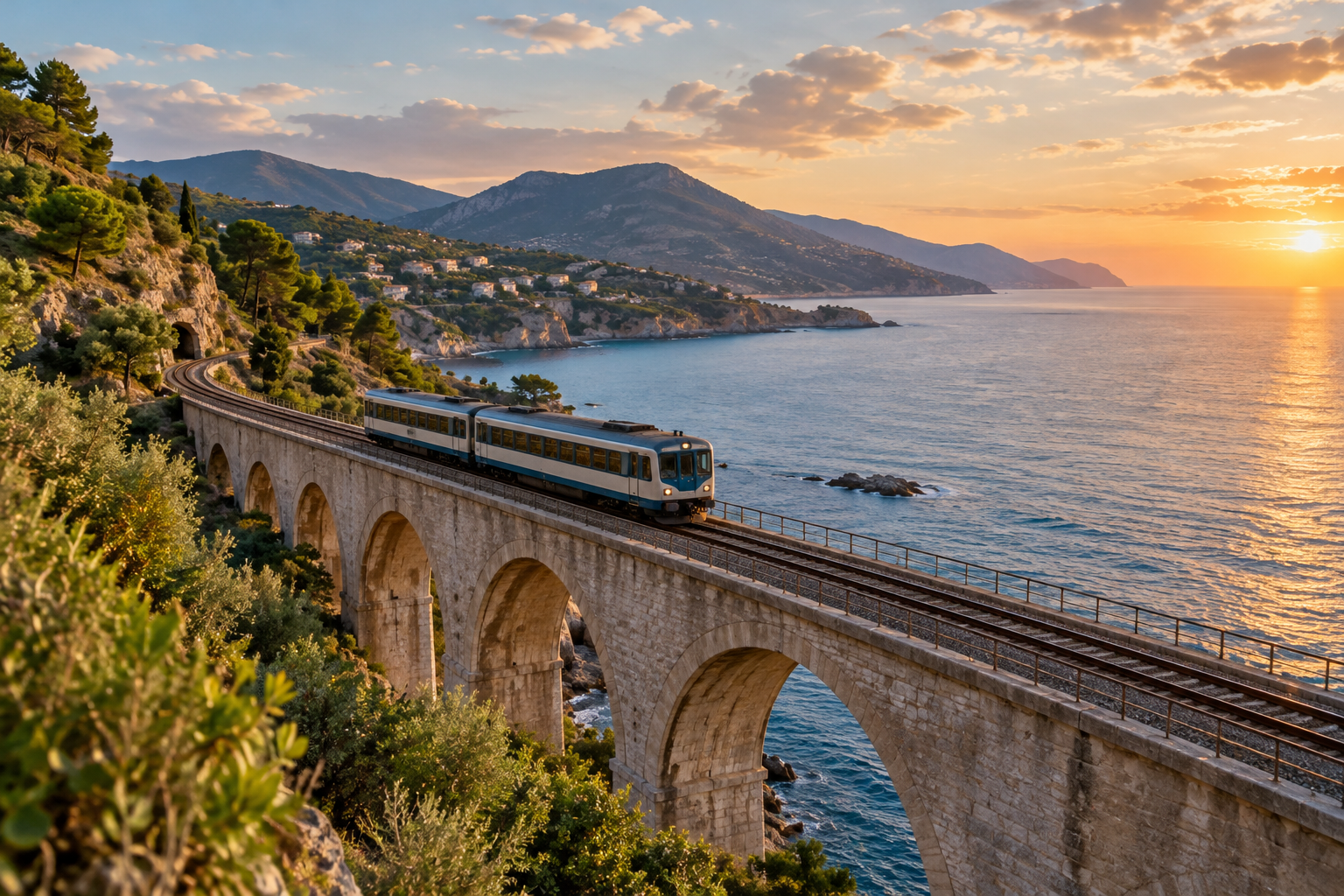
Image d’illustration générée par IA
For a manageable day exploring the French Riviera by train in November, choose one principal destination, keep any second stop optional, and build the outing around the return journey rather than a list of sights. Check the timetable for your actual travel date, establish how you will get from the station to your chosen waterfront or indoor destination, and decide which part of the visit deserves the available daylight.
A coastal lunch, a walk and one cultural stop can make a satisfying itinerary. You do not need to string together several towns to justify the journey. The more useful question is whether the route still appeals if the sea is grey, your preferred attraction is unavailable or you decide to walk less than expected.
Start with the day you want, not the number of stops
Before comparing trains, choose the experience you most want: time beside the water, an old-town wander, an indoor cultural visit or an unhurried meal followed by a short walk. Let that preference determine your destination.
For a first attempt, consider one of these planning patterns:
- A single-town outing, with a walk and an indoor alternative within a manageable area.
- A main destination plus a short second stop, added only if conditions and return options remain comfortable.
- An indoor-led day, with the coastal section treated as a welcome extra rather than the reason the whole trip must succeed.
Avoid making lunch, a museum visit and a second town equally essential. If each element is indispensable, there is little room to adapt.
For a separate moment of inspiration before narrowing the itinerary, consider browsing the Lifestyle page. Then return to the practical question: what would make this particular November day feel complete?
Choose a route that fits your starting point
Your base matters more than a destination’s reputation. A place that looks convenient on a regional map may require an awkward journey from your accommodation, especially once station access and the final walk are included.
Use Nice, Antibes, Cannes, Villefranche-sur-Mer, Monaco and Menton as candidates to investigate, not as a checklist to complete. Compare the actual station-to-destination journey for each place you are considering. Do not assume that arriving in a town means arriving beside its main attraction.
If you are starting in Nice, for example, compare two candidate destinations by searching the complete journey to each. Treat Antibes, Cannes, Villefranche-sur-Mer, Monaco or Menton as possible searches, not confirmed service recommendations. Check which trains operate on your date, where they stop and whether a change is required.
If you are staying elsewhere, make your nearest practical station the starting point. There is no need to route yourself through Nice simply because it is familiar.
Use a practical comparison table
Treat this table as a worksheet rather than a ranking. Fill it in using current journey information and your own walking preferences.
| Route pattern | Consider it when | Questions to resolve before leaving | What to remove first |
|---|---|---|---|
| One town, mainly outdoors | The forecast supports the walk you want | Where does the walk begin, and how will you return to the station? | Any extra neighbourhood detour |
| One town, indoor-led | You want an anchor independent of the waterfront | Is the venue available on your date, and is admission confirmed? | The longest outdoor section |
| Main town plus optional stop | You enjoy variety and can accept skipping something | Does the second stop leave a comfortable return margin? | The second stop itself |
| Short trip from your base | You prefer minimal travel and a flexible finish | Is the local station convenient at both ends? | A fixed sequence of activities |
| Meal-centred outing | Lunch is your main reason to travel | Is the restaurant open, and what happens if the meal takes longer? | A timed visit immediately afterwards |
Choose the pattern with the fewest unresolved questions, rather than the one with the most impressive itinerary.
Plan daylight before adding attractions
For a November outing, check local sunset for the exact date and decide when you want your outdoor section to end. Do not use an attractive summer itinerary without reconsidering its sequence.
Work backwards from that preferred finish. Allow time for the walk back, finding the correct platform and dealing with an unfamiliar station. Then decide how much time remains for lunch or an indoor visit.
A useful order might be waterfront first, lunch second and an indoor visit afterwards. On another day, a confirmed morning admission could be the anchor, with a short coastal walk later. Neither sequence is automatically better: choose the one that protects your priority.
Separate daylight wishes from transport requirements
You may be happy travelling back after dark while wanting to finish sightseeing earlier. Record those as two different decisions:
- The latest time you want to be on the waterfront or unfamiliar walking route.
- The return train you intend to take.
Leave a deliberate gap between them. Do not make the success of the day depend on walking quickly from a viewpoint straight onto a train.
Check sunset and weather again near departure. If the conditions no longer support your original outdoor plan, shorten the walk rather than trying to preserve every element.
Check the complete station-to-station journey
Look beyond the timetable when planning your outing. Map the journey from your accommodation to the departure platform, then from the arrival station to the place you actually want to visit.
Use the exact station name in your search. Where a destination has more than one station or several possible approaches, establish which one suits your plan. Examine walking directions rather than relying on the visual distance between two map pins.
For every candidate route, ask:
- Does the walking route involve steps, steep sections or a surface you would rather avoid?
- Is there an alternative if a lift or another access feature is unavailable?
- Can everyone in the group manage the return walk after lunch and sightseeing?
- Will bags, a pushchair or mobility equipment change the route choice?
- Where could you shorten the outing without creating a difficult return?
If step-free access is essential, verify the complete route through current official accessibility information. Do not rely on a general accessibility label to establish that every stage will work for your needs.
Consider comfort as carefully as distance. A short route that you would not enjoy in rain may be a worse choice than a slightly longer journey with a suitable indoor anchor.
Verify trains and attraction availability separately
Do not treat a saved journey search as a confirmed plan for every day of the week. Search the precise date and check the results again before travelling.
Use current official transport information to examine departure and arrival stations, changes, service notices, ticket conditions and the return options you are prepared to use. If different services appear in the results, check that your intended ticket is valid for the train you select.
Choose a preferred return and identify a fallback. Avoid casually relying on the final possible departure; decide in advance what you would do if your intended journey became unavailable.
Give each attraction its own check
Check each essential museum, garden, restaurant or other venue independently through its current official information, rather than treating your train search as the final planning step.
Before building the day around a venue, establish:
- Whether it is open on your exact date.
- Whether admission requires advance booking.
- Whether the particular space or activity you want is available.
- Whether entry conditions suit your group.
- Whether the location fits the station access and return plan.
If a crucial detail remains unclear, contact the venue or replace it with a less conditional plan. Do not fill the gap with an assumption based on an old listing.
Build a weather alternative you would genuinely enjoy
A useful fallback is a second version of the day, not simply an instruction to find shelter. Choose it before leaving, and check it with the same care as the outdoor itinerary.
For a waterfront-led outing, identify one indoor option and a shorter walking loop. For a meal-led outing, decide whether lunch alone would justify the journey if you abandoned sightseeing. For a two-stop itinerary, make the first destination sufficiently appealing on its own.
Review the forecast for the destination, not just your departure point. Consider rain, wind and any official warnings relevant to your intended walk. If conditions raise doubts about a waterfront section, omit it rather than treating completion as an achievement.
Keep optional browsing of the Magazine page separate from checking your fallback. For any specific venue you choose, consult its own current availability information before including it in the day.
Agree on the decision before departure
Decide what would trigger a change of plan. That might be persistent rain during your intended walking period, an unavailable indoor venue or a return journey that no longer feels comfortable.
Keep the response simple: shorten, substitute or postpone. Avoid replacing one uncertain itinerary with several improvised stops.
A step-by-step planning method
Use this sequence to turn a general idea into a workable outing.
1. Set your boundaries
Write down your starting point, preferred departure window and latest comfortable return. Add the walking level that suits everyone involved. Be honest about whether you want a full day or a relaxed excursion.
2. Compare two destinations
For each, check the outward journey, return choices and station-to-activity route. Comparing two serious candidates is more useful than collecting a long list without examining access.
3. Choose one anchor
Select the walk, meal or cultural visit that gives the day its purpose. Verify any booking or opening conditions attached to it. Everything else should fit around this anchor rather than compete with it.
4. Place the outdoor section
Check sunset and the forecast, then choose when to walk. Keep an easy point at which you can turn back or end the route.
5. Add a fallback
Choose an alternative you would willingly do, and verify it. If no appealing fallback exists, consider a different destination or a shorter commitment.
6. Save the essentials
Keep your tickets or booking details, exact station names, walking route and return options accessible. Save any information you may need without a reliable connection.
7. Recheck before leaving
Review service notices, weather and essential venue information. Make the final route choice before setting out, while retaining permission to simplify it later.
Three fictional day-out scenarios
The following examples are fictional planning exercises, not verified itineraries. They illustrate decisions to test against current conditions.
A waterfront-first visit to Villefranche-sur-Mer
A traveller based in Nice wants a coastal walk and lunch, without a packed schedule. They investigate Villefranche-sur-Mer as their sole destination, checking the train, walking approach and return options before committing.
They plan the outdoor section first and leave lunch flexible. If the walking route or forecast does not suit them, they choose another destination rather than assuming that a short rail journey guarantees an easy outing.
An indoor-led day in Antibes
Two friends want time for a cultural visit and conversation over lunch. They consider Antibes, but make their decision conditional on confirming a suitable venue and manageable station access.
Their waterfront walk remains optional. If lunch runs longer than expected, they drop the walk rather than hurry through the confirmed visit or compress the return margin.
A deliberate single-destination trip to Menton
A couple considers Menton from their Riviera base. After checking the journey, they decide that the travel commitment makes it their only destination.
They select one walking area, investigate an indoor alternative and choose a return that suits their evening plans. They resist adding another destination merely to make the itinerary look more substantial.
Errors worth examining before you go
The most ambitious plan is not necessarily the most enjoyable. Look for these weaknesses before booking anything conditional.
- Counting towns rather than choosing experiences. Ask what each additional stop contributes.
- Assuming the station is the destination. Check the complete walking route in both directions.
- Leaving the best outdoor section until the end. Decide whether it deserves earlier daylight.
- Treating a restaurant as an automatic fallback. Verify availability before depending on it.
- Scheduling tightly around a train. Preserve room for finding the platform and changing your mind.
- Keeping a second stop after conditions change. Remove optional elements promptly.
- Relying on another traveller’s old itinerary. Recheck the operational details for your date.
For future reading, keep the Lookbook homepage separate from your practical trip notes. Inspiration can remain broad; the day’s transport, access and availability checks should be specific.
FAQ
How many towns should I plan to visit in one day?
Start with one principal destination. Consider a second only after confirming the journeys, walking requirements and return margin. Make it optional, so skipping it does not feel like abandoning the day.
Should I book lunch or a cultural visit first?
Book whichever is the genuine purpose of the outing, after checking the train journey and access. Avoid creating several fixed commitments until you know they fit comfortably together.
What should I do if rain is forecast?
Compare an indoor-led version with a shorter outdoor outing. Verify the alternative before travelling. If neither appeals, reconsider the destination or postpone rather than preserving the original route at all costs.
What information should I check on the morning of travel?
Review current train information, the destination forecast, essential venue availability and any access notices relevant to your route. Confirm your intended return and fallback, then keep the itinerary simple enough to change without losing its main purpose.