
Valentino’s House united couture,cinema, and lifestyle into a single inhabitable universe
From winning the International Fashion Design Prize 2023 to editorial consecration at Paris Fashion Week, and a refined nomadic presence across Europe: the designer constructs a vision where elegance, technology, and life converge and couture becomes a space to inhabit.
Victoria Su belongs to that rare category of contemporary fashion authors for whom the image is never mere representation, but part of a coherent puzzle the construction of an entire universe, a lifestyle. A designer, visual artist, and now film director, she has developed in recent years a recognizable language that fuses volume, technology, and visual silence into an aesthetic now directly associated with her name.
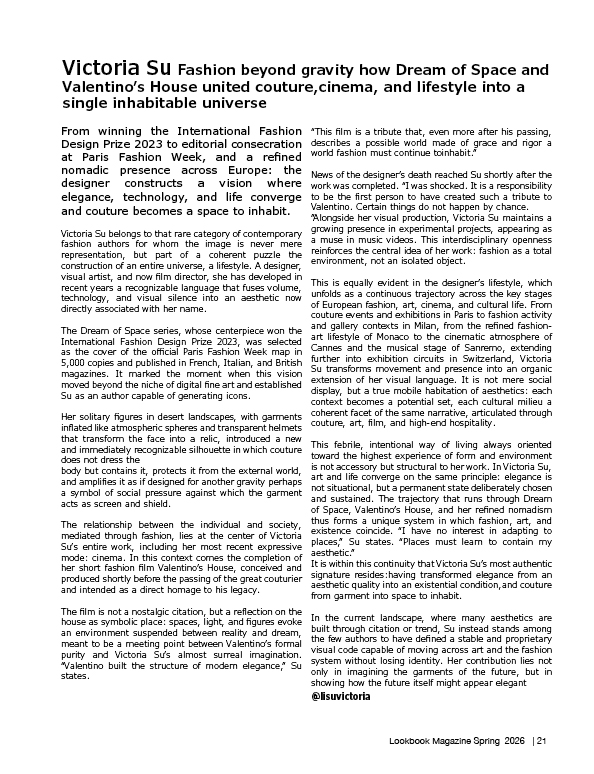
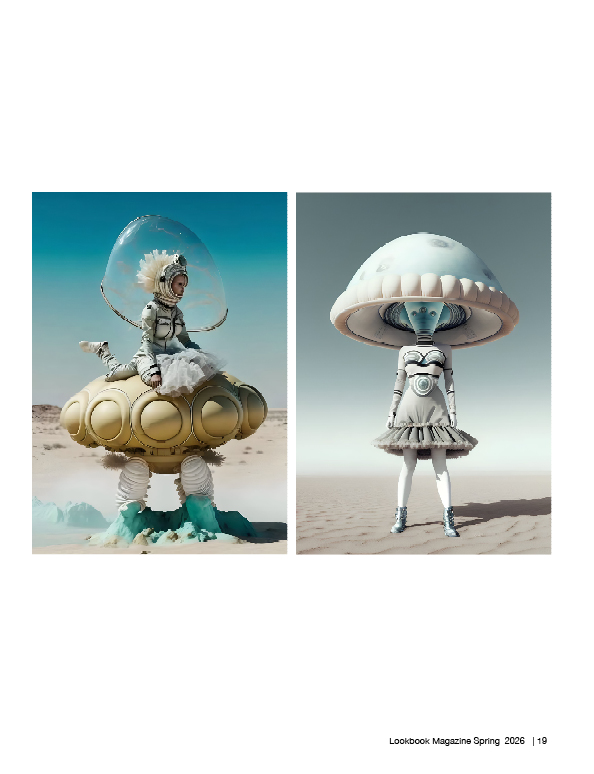
The Dream of Space series, whose centerpiece won the International Fashion Design Prize 2023, was selected as the cover of the official Paris Fashion Week map in 5,000 copies and published in French, Italian, and British magazines. It marked the moment when this vision moved beyond the niche of digital fine art and established Su as an author capable of generating icons.
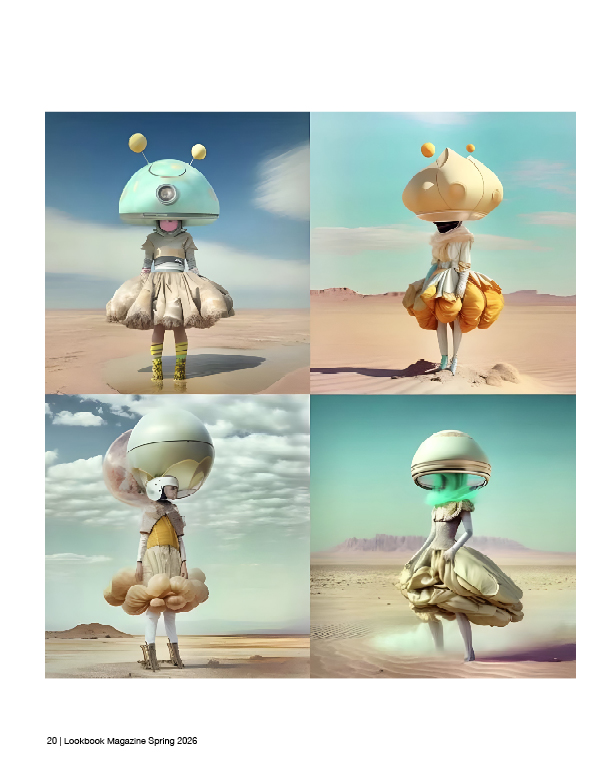
Her solitary figures in desert landscapes, with garments inflated like atmospheric spheres and transparent helmets that transform the face into a relic, introduced a new and immediately recognizable silhouette in which couture does not dress the
body but contains it, protects it from the external world, and amplifies it as if designed for another gravity perhaps a symbol of social pressure against which the garment acts as screen and shield.
The relationship between the individual and society, mediated through fashion, lies at the center of Victoria Su’s entire work, including her most recent expressive mode: cinema. In this context comes the completion of her short fashion film Valentino’s House, conceived and produced shortly before the passing of the great couturier and intended as a direct homage to his legacy.
The film is not a nostalgic citation, but a reflection on the house as symbolic place: spaces, light, and figures evoke an environment suspended between reality and dream, meant to be a meeting point between Valentino’s formal purity and Victoria Su’s almost surreal imagination. “Valentino built the structure of modern elegance,” Su states.
“This film is a tribute that, even more after his passing, describes a possible world made of grace and rigor a world fashion must continue toinhabit.”
News of the designer’s death reached Su shortly after the work was completed. “I was shocked. It is a responsibility to be the first person to have created such a tribute to Valentino. Certain things do not happen by chance.
”Alongside her visual production, Victoria Su maintains a growing presence in experimental projects, appearing as a muse in music videos. This interdisciplinary openness reinforces the central idea of her work: fashion as a total environment, not an isolated object.
This is equally evident in the designer’s lifestyle, which unfolds as a continuous trajectory across the key stages of European fashion, art, cinema, and cultural life. From couture events and exhibitions in Paris to fashion activity and gallery contexts in Milan, from the refined fashion-art lifestyle of Monaco to the cinematic atmosphere of Cannes and the musical stage of Sanremo, extending further into exhibition circuits in Switzerland, Victoria Su transforms movement and presence into an organic extension of her visual language. It is not mere social display, but a true mobile habitation of aesthetics: each context becomes a potential set, each cultural milieu a coherent facet of the same narrative, articulated through couture, art, film, and high-end hospitality.
This febrile, intentional way of living always oriented toward the highest experience of form and environment is not accessory but structural to her work. In Victoria Su, art and life converge on the same principle: elegance is not situational, but a permanent state deliberately chosen and sustained. The trajectory that runs through Dream of Space, Valentino’s House, and her refined nomadism thus forms a unique system in which fashion, art, and existence coincide. “I have no interest in adapting to places,” Su states. “Places must learn to contain my aesthetic.”
It is within this continuity that Victoria Su’s most authentic signature resides:having transformed elegance from an aesthetic quality into an existential condition,and couture from garment into space to inhabit.
In the current landscape, where many aesthetics are built through citation or trend, Su instead stands among the few authors to have defined a stable and proprietary visual code capable of moving across art and the fashion system without losing identity. Her contribution lies not only in imagining the garments of the future, but in showing how the future itself might appear elegant
@lisuvictoria