
The botany of human relationships
In the new chapter of his “Goddesses & Muses” series, Salvi uses flowers as an emotional language, turning human bonds into living presences between contemporary myth, nature, and self-healing.
When winter ends, flowers return. In this renewed turn toward light and life comesthe latest chapter in the work of Italian multisensory artist Daniel Salvi: FLOWERS.
Born in 1994 and based in the countryside of Milan, Salvi has long pursued a clear idea: transforming visual art into a hidden emotional refuge, where people can recover and regain strength to face the chaos of the outside world. His practice blends photography, artificial intelligence, digital painting, and retouching, and expands beyond the visual through original soundtracks and olfactory art turning viewing into an immersive ritual.
In his series Goddesses & Muses, Salvi reinterprets the classical and Renaissance archetypes of Italian art to speak to the present about femininity, the human condition, and our often-fragile relationship with nature. In this universe, Salvi’s divine and mythological figures are not decorative icons: they are presences that look back, engage the viewer, and raise essential questions. And they ask for something rare: time.
FLOWERS grows out of this world and introduces an almost unprecedented shift for the artist. Unlike many of Salvi’s works often unique pieces, emphasizing the exclusivity of the subject’s presence and the unrepeatability of the encounter this series belongs to his rare field of Limited Editions, allowing art to circulate as a gesture and become a means of communication between people, strengthening meaningful bonds.
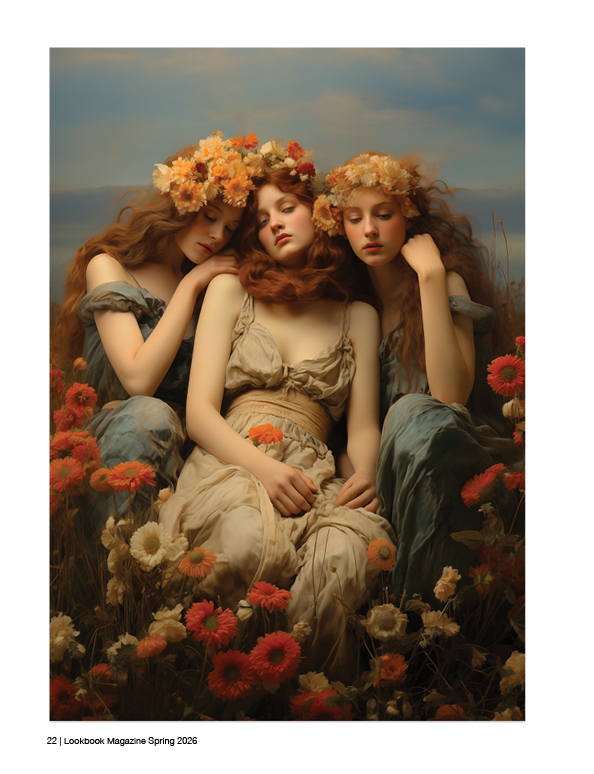
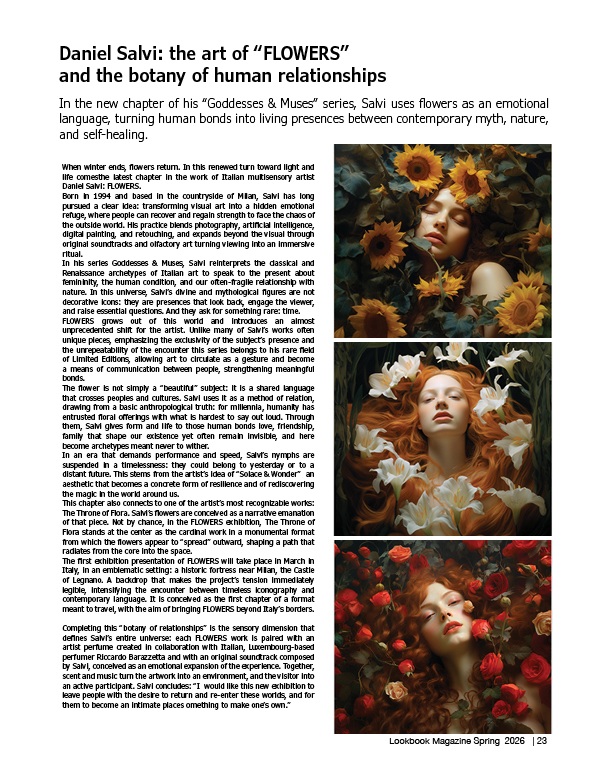
The flower is not simply a “beautiful” subject: it is a shared language that crosses peoples and cultures. Salvi uses it as a method of relation, drawing from a basic anthropological truth: for millennia, humanity has entrusted floral offerings with what is hardest to say out loud. Through them, Salvi gives form and life to those human bonds love, friendship, family that shape our existence yet often remain invisible, and here become archetypes meant never to wither.
In an era that demands performance and speed, Salvi’s nymphs are suspended in a timelessness: they could belong to yesterday or to a distant future. This stems from the artist’s idea of “Solace & Wonder” an aesthetic that becomes a concrete form of resilience and of rediscovering the magic in the world around us.
This chapter also connects to one of the artist’s most recognizable works: The Throne of Flora. Salvi’s flowers are conceived as a narrative emanation of that piece. Not by chance, in the FLOWERS exhibition, The Throne of Flora stands at the center as the cardinal work in a monumental format from which the flowers appear to “spread” outward, shaping a path that radiates from the core into the space.
The first exhibition presentation of FLOWERS will take place in March in Italy, in an emblematic setting: a historic fortress near Milan, the Castle of Legnano. A backdrop that makes the project’s tension immediately legible, intensifying the encounter between timeless iconography and contemporary language. It is conceived as the first chapter of a format meant to travel, with the aim of bringing FLOWERS beyond Italy’s borders.
Completing this “botany of relationships” is the sensory dimension that defines Salvi’s entire universe: each FLOWERS work is paired with an artist perfume created in collaboration with Italian, Luxembourg-based perfumer Riccardo Barazzetta and with an original soundtrack composed by Salvi, conceived as an emotional expansion of the experience. Together, scent and music turn the artwork into an environment, and the visitor into an active participant. Salvi concludes: “I would like this new exhibition to leave people with the desire to return and re-enter these worlds, and for them to become an intimate places omething to make one’s own.”
danielsalvi.art